Rock Chips, Road Rash, and Paint Scratches in Las Vegas: When Paint Correction Is the Right Call
Las Vegas drivers deal with a specific kind of paint abuse that’s different from most cities. The combination of fast freeway driving on I-15, I-215, and US-95, desert gravel on surface streets, construction zones scattered across the valley, and alkaline dust that coats your car overnight creates conditions where paint damage shows up fast — and gets worse if you ignore it.
Rock chips, road rash, and scratches are different problems that require different solutions. Understanding which type of damage you have is the first step toward actually fixing it — and avoiding paying for a service that won’t help.
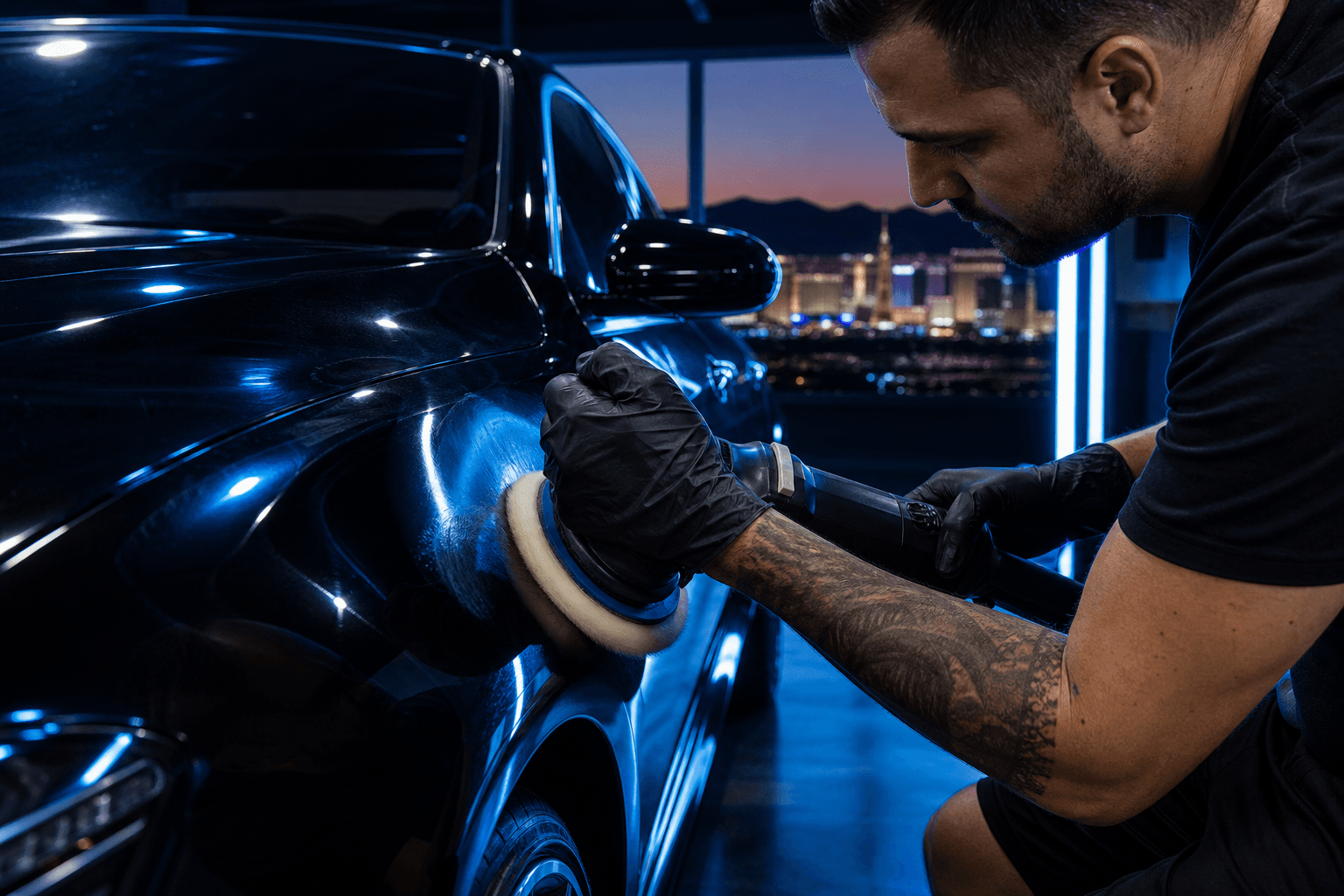
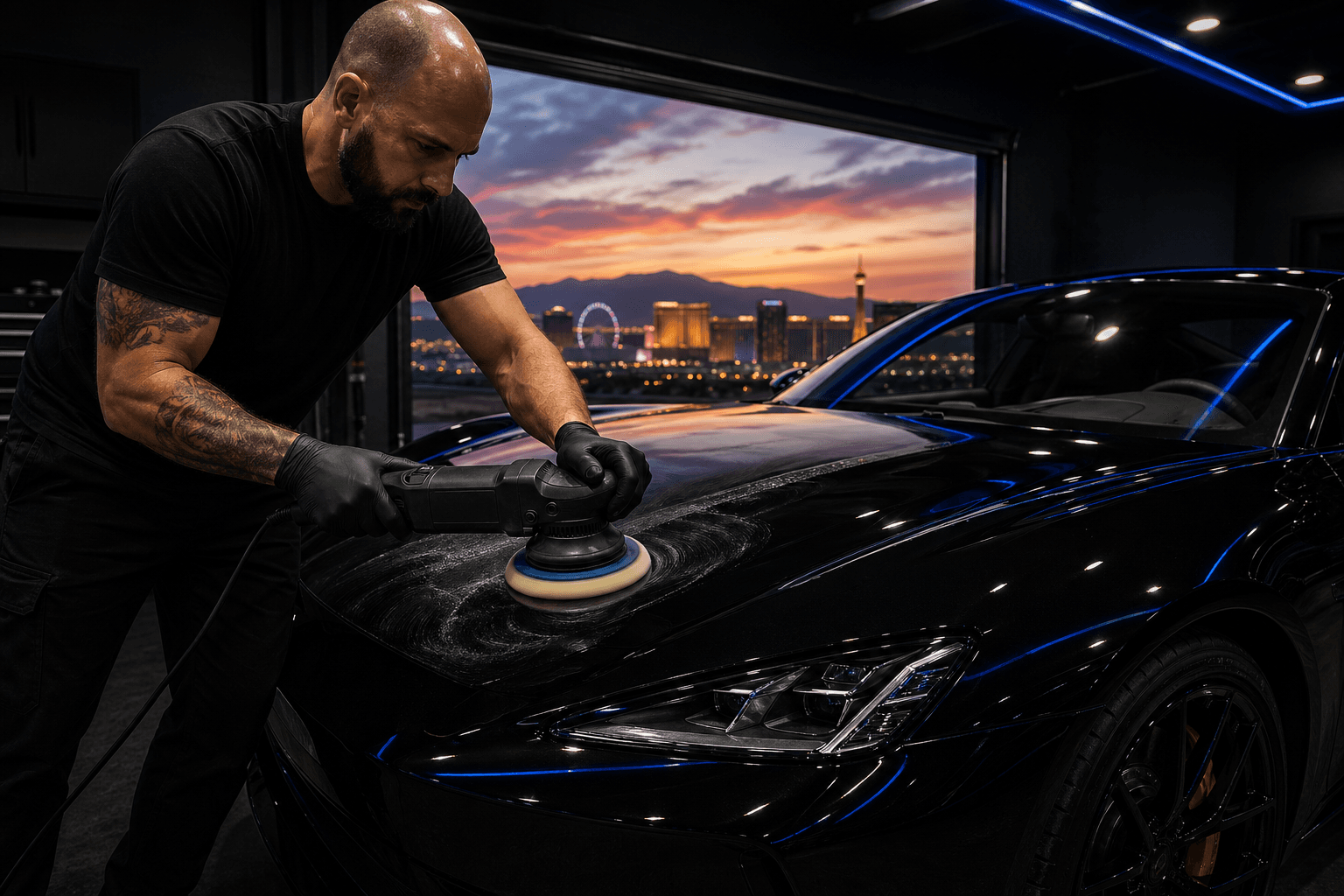
At AOA Detailing, Kevin and his team perform mobile paint correction across Las Vegas, Henderson, Summerlin, and the greater Las Vegas valley. This guide explains exactly what each type of surface damage is, when paint correction can fix it, and what to do when it can’t.
Quick Summary
- Rock chips that reach bare metal require touch-up paint or professional chip repair — paint correction alone cannot fill chips
- Road rash (micro-abrasion from fine road debris) is often correctable with paint correction
- Surface scratches in the clear coat are excellent candidates for paint correction
- Deep scratches that reach the primer or metal need bodywork first, then paint correction as a finishing step
- AOA Detailing offers mobile paint correction across all Las Vegas neighborhoods — call Kevin at (775) 244-5315
Table of Contents
- What Las Vegas Does to Your Paint
- Rock Chips: What They Are and What Can Be Done
- Road Rash: The Damage You Might Not Notice
- Surface Scratches vs. Deep Scratches
- What Paint Correction Actually Fixes
- The Paint Correction Process
- After Paint Correction: Protecting Your Investment
- AOA Detailing’s Paint Correction Approach
- Frequently Asked Questions
- Book Mobile Paint Correction in Las Vegas
What Las Vegas Does to Your Paint
Las Vegas is hard on paint in ways that aren’t always obvious until you look closely.
Highway gravel and construction debris. Las Vegas is perpetually under construction. US-95 expansions, I-15 interchange projects, and constant residential development mean gravel, sand, and debris on roads at all times. At freeway speeds, these particles hit your hood and front bumper with significant force.
Alkaline dust. The Mojave Desert soil has high alkalinity. When alkaline dust sits on paint and gets wet — even just from morning dew — it creates a chemical reaction that etches the clear coat over time. This is separate from mechanical scratching, but it compounds the damage.
Extreme UV. Las Vegas UV levels cause paint oxidation, particularly on older or unprotected vehicles. Oxidized clear coat is softer and scratches more easily, meaning every rock chip and every road rash mark looks worse on an oxidized surface than a protected one.
Temperature cycling. Daily temperature swings from the 60s at night to 110°F+ in summer cause your car’s panels to expand and contract constantly. This thermal stress can open micro-cracks in the clear coat, giving contaminants a pathway to accelerate deeper damage.
Understanding this environment helps explain why Las Vegas vehicles often look worse than comparable-year vehicles in milder climates — and why proactive paint care matters more here.
Rock Chips: What They Are and What Can Be Done
A rock chip happens when a stone or piece of road debris impacts your paint with enough force to physically remove material — often all the way through the clear coat and color coat to the primer or bare metal.
What a rock chip looks like:
- A small, usually circular or irregular spot where paint is missing
- Often surrounded by a small ring of chipped or lifted paint
- The center may appear white (primer), silver (aluminum), or dark (steel)
- Common locations: hood, front bumper, leading edge of the roof, door edges
Can paint correction fix rock chips?
No — and this is the most important thing to understand about paint correction’s limits. Paint correction is a process of removing a thin layer of clear coat by abrasion to eliminate surface imperfections within the clear coat. If material is already missing, correction cannot replace it.
What you actually need for rock chips:
- Touch-up paint: For small chips, color-matched touch-up paint fills the void and prevents rust. Results are good but rarely invisible under close inspection.
- Professional chip repair: A detailer or body shop can blend touch-up paint more precisely, sometimes making chips nearly invisible on solid-color or metallic paints.
- Rock chip repair (resin injection): For very small chips, some technicians use clear resin to fill the void and level the surface, similar to windshield chip repair.
Where paint correction fits in:
After a rock chip is repaired with touch-up paint, the area often has a slightly raised or textured surface. Paint correction can be used as a finishing step after chip repair to smooth and blend the repaired area into the surrounding paint. In this context, correction complements chip repair rather than replacing it.
Road Rash: The Damage You Might Not Notice
Road rash is different from a chip. It refers to a diffuse pattern of micro-abrasion from fine road debris — sand, grit, and small particles — that sandblasts your paint over time, particularly the front fascia, hood, and lower side panels.
What road rash looks like:
- Dull, hazy, or cloudy appearance on the lower third of your front bumper
- Under direct sunlight, a “sandblasted” texture or thousands of tiny scratches visible
- Often mistaken for paint oxidation, but road rash has directional patterns
- More pronounced on vehicles that regularly drive at freeway speeds
Can paint correction fix road rash?
Often yes — and this is where paint correction excels. Because road rash lives in the clear coat layer (the top 3–5 mil of your paint system), an aggressive polish or compound followed by a finishing polish can remove the micro-scratched layer and restore clarity and gloss.
The key variable is depth. Very aggressive road rash that has worn through the clear coat is no longer correctable. But the majority of road rash that appears severe is actually surface-level, and paint correction can dramatically improve it.
AOA Detailing’s paint correction services start at $550, which includes a multi-stage machine polish process designed for exactly this type of diffuse surface damage.
Surface Scratches vs. Deep Scratches
Not all scratches are equal. The layer a scratch reaches determines whether paint correction can fix it.
The paint system layers (outside to inside):
- Clear coat (~1.5–2.5 mil) — transparent protective layer
- Color coat / base coat (~0.5–1 mil) — the pigmented layer that gives your car its color
- Primer (~0.5–1 mil) — adhesion layer between color and metal
- Metal or substrate
Surface scratches (clear coat only):
- Common causes: improper washing (using dirty sponges, drive-through car washes), light keying, shopping cart contact, brush contact
- Key test: run your fingernail across the scratch — if your nail doesn’t catch, it’s likely in the clear coat only
- Excellent paint correction candidates — a skilled technician can often make clear coat scratches disappear completely
Mid-depth scratches (into the color coat):
- The scratch has a white or off-white appearance rather than showing the true color of the panel
- The color coat has been abraded away in spots
- Paint correction can reduce visibility but may not eliminate the scratch entirely — depends on depth and paint thickness
Deep scratches (into primer or metal):
- The scratch appears very light (primer) or metallic/rust-tinged (bare metal)
- Paint correction cannot fix these — bodywork and respray are required
- After body repair, paint correction can be used to smooth and blend the repaired area
The fingernail test is your quick field diagnosis. But for a definitive assessment, Kevin’s team uses paint depth gauges to measure how much clear coat remains and determine what’s correctable.
What Paint Correction Actually Fixes
Paint correction’s wheelhouse — the damage types it’s specifically designed to address:
Excellent candidates:
- Swirl marks from improper washing (the most common Las Vegas paint problem)
- Water spot etching from hard water (Las Vegas has some of the hardest water in the country)
- Oxidation and hazing on older clear coats
- Light road rash in the clear coat layer
- Buffer trails left by previous poor machine polishing
- Clear coat scratches (no fingernail catch)
- Hologram marks from high-speed polishing
- Surface contamination that can’t be removed chemically
Good candidates (significant improvement, may not achieve perfection):
- Shallow scratches into the color coat
- Moderate road rash with some depth
- Water spot etching that has slightly penetrated the clear coat
Not correctable:
- Rock chips (material removal — need fill/repair first)
- Deep scratches into primer or metal
- Clear coat peeling or delamination
- Dents and dings (physical panel deformation)
- Rust (requires metal preparation and respray)
The Paint Correction Process
AOA Detailing’s paint correction approach is a systematic multi-stage process:
Stage 1: Decontamination wash
The vehicle is thoroughly washed using a foam cannon, pH-neutral soap, and a two-bucket method to remove all loose contamination. A clay bar treatment removes bonded contamination (industrial fallout, tree sap, road tar) that would interfere with correction.
Stage 2: Paint thickness measurement
Using a digital paint gauge, Kevin checks clear coat thickness across multiple panels. This tells us how much material we have to work with and how aggressive we can be with correction compounds.
Stage 3: Test panel
Before treating the whole vehicle, a small test section is corrected to dial in the right compound and pad combination. Different paints respond differently — soft European paints vs. hard Japanese paints vs. domestic paints all require different approaches.
Stage 4: Compounding (if needed)
For heavy oxidation, deep road rash, or significant swirl marks, a cutting compound removes the most material. This is the most aggressive step and creates visible marring in the micro-scratches it leaves behind — which is removed in the next stage.
Stage 5: Finishing polish
A finishing polish with a softer pad refines the surface left by compounding, removing any remaining micro-marring and bringing the paint to full gloss.
Stage 6: Inspection
Under LED inspection lighting, the entire vehicle is inspected for any remaining defects. Areas that need additional attention are spot-corrected.
Stage 7: Paint protection (recommended)
Paint correction removes the damaged clear coat layer. The fresh surface underneath needs immediate protection — either a ceramic coating (preferred) or a quality carnauba wax. AOA Detailing strongly recommends ceramic coating after paint correction, as it provides 3–5 years of protection that prevents the same damage from occurring again.
After Paint Correction: Protecting Your Investment
Paint correction restores your paint — but the damage returned because your original protection failed. Leaving freshly corrected paint unprotected means you’re back to the same problem within a few months.
Option 1: Ceramic coating (recommended)
A ceramic coating creates a 9H-hardness protective layer over the corrected clear coat. In Las Vegas’s environment, ceramic coatings are particularly valuable because they’re chemically resistant to the alkaline dust and UV radiation that cause ongoing damage. AOA Detailing’s ceramic coating packages range from $1,000 to $1,650 depending on vehicle size and package level.
The combination of paint correction + ceramic coating is the most common service Kevin performs — correction first to remove existing damage, then coating to prevent future damage.
Option 2: Paint Protection Film (PPF)
For the front end specifically — where rock chips concentrate — PPF (clear bra) applied over freshly corrected paint is the most effective protection available. PPF physically absorbs impacts and is self-healing for minor scratches.
Option 3: Carnauba wax or paint sealant
More affordable but shorter-lived. Wax and sealants provide 1–3 months of protection in Las Vegas heat before breaking down. They’re a reasonable interim solution if ceramic coating isn’t in the budget right away.
AOA Detailing’s Paint Correction Approach
Kevin founded AOA Detailing with a focus on results that actually show under inspection lighting — not just in photos with flattering angles. AOA Detailing serves all of Las Vegas and surrounding areas:
All services are mobile — Kevin and his team come to you with professional-grade equipment. No need to drop off your car or arrange rides.
Paint correction pricing:
- Single-stage correction: $550
- Two-stage correction: from $700
- Multi-stage correction with ceramic coating: $1,000–$1,650+
Frequently Asked Questions
Can rock chips on my hood be fixed without repainting?
Usually yes, but not with paint correction alone. Touch-up paint or professional chip fill is the right approach. Paint correction can then smooth the repaired area. Kevin assesses each chip situation individually — call (775) 244-5315 for a quote.
How do I know if my scratches are in the clear coat or color coat?
The fingernail test: drag your fingernail across the scratch at a right angle. If your nail glides over it, the scratch is likely in the clear coat. If it catches, it’s deeper. For a definitive assessment, Kevin uses a paint depth gauge.
Is paint correction worth it before trading in my car?
Often yes, because a well-corrected finish photographs significantly better and the difference in trade-in or private sale value often exceeds the cost of correction.
How long does paint correction last?
The correction itself is permanent — the removed material doesn’t grow back. But new swirls and scratches will appear if the paint isn’t protected and properly maintained. A ceramic coating applied after correction is the best way to extend the results for years rather than months.
Does AOA Detailing come to my location?
Yes. All AOA Detailing services are fully mobile. Kevin serves within 25 miles of Las Vegas, covering Henderson, Summerlin, North Las Vegas, Spring Valley, Boulder City, and more.
Book Mobile Paint Correction in Las Vegas
If your Las Vegas vehicle has rock chips, road rash from freeway driving, or scratch damage from parking lots, don’t wait. Paint damage that’s caught early is correctable. Left alone, moisture and UV reach the layers underneath and turn a correction job into a repaint job.
Kevin at AOA Detailing has years of experience diagnosing and correcting paint damage across Las Vegas, Henderson, and Summerlin. We bring professional-grade equipment to your location — skip the shop and get results delivered to your driveway.
Call or text Kevin: (775) 244-5315
Book online at aoa-detailing.com/book. Service area: 25 miles from Las Vegas — Henderson, Summerlin, North Las Vegas, Spring Valley, Boulder City, Centennial Hills.