What Are Swirl Marks, Exactly?
If you’ve ever looked at your car under the bright Las Vegas sun and noticed a web of fine circular scratches swirling across the paint — especially on darker colors — you’re looking at swirl marks. They’re one of the most common paint defects we see at AOA Detailing, and they’re almost entirely caused by well-intentioned car washing.
Swirl marks are microscopic scratches in your vehicle’s clear coat — the transparent protective layer applied over the base color. Under normal lighting, clear coat looks glossy and smooth. Under direct, harsh light (like Las Vegas summer sun hitting your hood at noon), that surface reflects light in every direction, making those tiny scratches visible as a hazy, circular pattern.
They’re called swirl marks because of the shape: circular arcs left by rotary motion — either an automatic car wash brush spinning against the paint, a microfiber cloth being rubbed in circles, or a chamois dragged across grit during drying.
The scratches themselves are extremely shallow — typically measured in microns, not millimeters. Your clear coat is usually 40–80 microns thick (thinner than a human hair), and swirl marks occupy only the top few microns. That’s why they can be polished out without removing the protective layer entirely — as long as you catch them before they compound into deeper damage.
What swirl marks are NOT:
- Rock chips (those penetrate through clear coat into the base coat)
- Deep scratches that catch your fingernail
- Rust or oxidation (a different type of paint degradation)
- Holograms from improper polishing (a related but distinct defect)
Why Las Vegas Cars Get Swirl Marks Faster
Las Vegas doesn’t just accelerate swirl marks — it creates a perfect storm of contributing factors:
Desert Dust Is Coarser Than Most People Realize
Southern Nevada sits in the Mojave Desert. The particulate matter that settles on your car every day includes fine quartz silica dust from nearby desert floors and construction sites along the 215 corridor and Summerlin Parkway. Quartz registers 7 on the Mohs hardness scale. Automotive clear coat registers around 2–3. Every time a dry cloth or brush contacts that dust on your paint, it’s being dragged across material harder than the surface it’s supposed to protect.
The standard advice — “wipe dust off with a dry cloth between washes” — is particularly damaging in Las Vegas because of this silica content. What seems like a quick cleanup is actually an abrasion event.
Automatic Car Washes Are Everywhere — and Problematic
The Las Vegas valley is dotted with drive-through car washes, and they’re genuinely convenient. But the rotating brushes and cloth strips used in most automatic washes are aggressive enough to cause swirl marks on a clean car — let alone one coated in desert dust. Even “touchless” laser washes use high-pressure jets at angles that can cause micro-abrasion.
We remove swirl marks caused by automatic car wash brushes from vehicles every week. It’s one of the most common scenarios we see.
Hard Water Spots Create Abrasive Mineral Deposits
Las Vegas tap water is among the hardest in the country, with extremely high concentrations of calcium and magnesium. When water from sprinklers, rain, or a poorly rinsed wash dries on your paint, it leaves behind white mineral deposits. Those deposits feel gritty to the touch and create an abrasive layer between your paint and anything that contacts it — including the microfiber you use to wipe them away. Wiping a mineral-spotted panel is essentially the same as wiping a dusty one.
UV Degradation Softens Clear Coat
Prolonged UV exposure at Las Vegas intensity (we average 294 sunny days per year) gradually degrades the chemical structure of clear coat, making it softer and more susceptible to abrasion. A car with UV-weakened clear coat accumulates swirl marks from light contact that a well-protected, freshly coated car would shrug off.
How Paint Correction Removes Swirl Marks
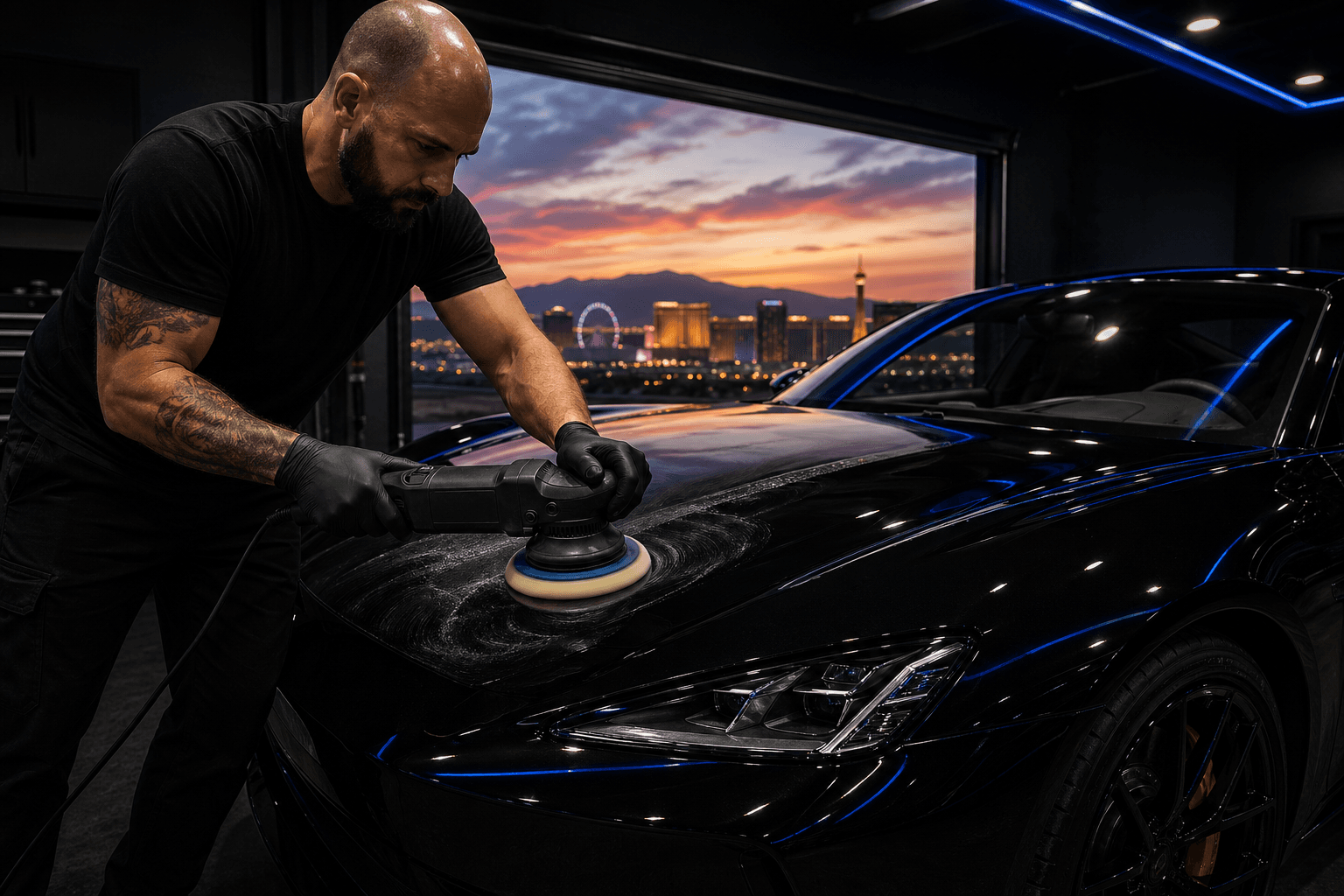
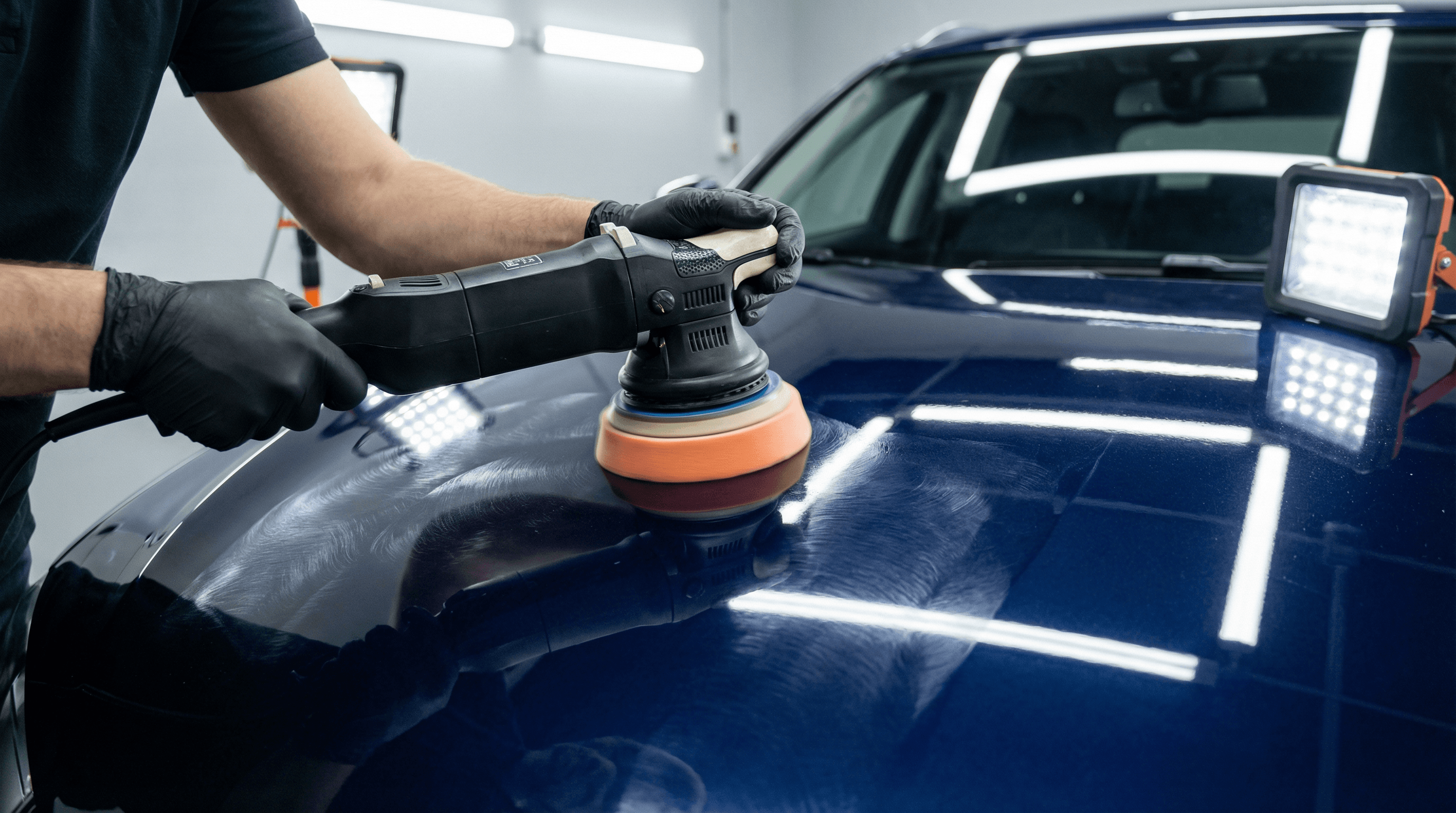
Paint correction is the process of mechanically polishing the clear coat to remove or reduce the layer of material containing the scratches. Kevin, Founder of AOA Detailing, performs this process using professional-grade dual-action and rotary polishers with progressively finer compounds and polishing pads.
Here’s how the stages work:
Stage 1 — Paint Inspection and Thickness Testing
Before touching any polish to paint, we measure the paint thickness at multiple points across all panels using a digital paint depth gauge. This tells us exactly how much clear coat is present and how much correction work the surface can safely support. We’re protecting your car, not just chasing results.
We also inspect under detailing lights to map the defect types present: light swirls, deeper single-track scratches, water spot etching, oxidation, or buffer trails from previous machine polishing.
Stage 2 — Decontamination
Correction only works on clean, decontaminated paint. We clay-bar the entire vehicle to remove bonded contaminants — industrial fallout, road tar, brake dust particles, and mineral deposits — that would otherwise interfere with the polishing process. Attempting to polish over embedded contamination causes new scratches.
Stage 3 — Machine Polishing
We match the compound and pad combination to the defect severity identified in the inspection:
One-Step Correction (Light Swirls)
A single pass with a finishing compound removes light swirl marks and restores clarity. This is the most common scenario for vehicles that have been regularly washed but haven’t had professional correction.
Two-Stage Correction (Moderate Defects)
A cutting compound breaks down deeper scratches in the first stage; a lighter polishing compound in the second stage refines the surface and maximizes gloss. This handles moderate swirling plus water spot etching or light oxidation.
Multi-Stage Correction (Heavy Defects)
Reserved for vehicles with significant oxidation, deep buffer trails, heavy scratching, or paint that’s never been professionally corrected. Multiple passes at progressively finer stages restore even heavily neglected paint.
Stage 4 — Gloss Enhancement and Inspection
After polishing, we inspect under multiple lighting conditions — including direct sunlight — to verify correction levels. Any remaining defects are addressed before we move to the protection step.
Paint Correction Results: What to Expect
The difference between a pre- and post-correction paint surface under direct Las Vegas sunlight is dramatic. A dark-colored car that looked hazy and grey in the sun becomes deep and reflective — the kind of finish that makes people stop and look in parking lots.
Realistic expectations by defect level:
- Light swirls → 85–95% removal typical with one-step correction
- Moderate swirls and water spot etching → 80–90% removal with two-stage correction
- Heavy scratches and oxidation → significant improvement; deeper scratches that reach the base coat can be reduced but not eliminated without respray
Kevin, Founder of AOA Detailing, will give you an honest assessment during the inspection — we don’t overpromise, and we don’t start work without explaining what’s achievable on your specific vehicle.
Protecting the Results: Ceramic Coating After Correction
Paint correction restores your clear coat. What it doesn’t do is prevent the same damage from happening again. Without protection, swirl marks will return — Las Vegas dust and car washes don’t stop.
This is why we strongly recommend pairing paint correction with a ceramic coating immediately after the correction process.
A properly applied ceramic coating bonds chemically to the freshly polished clear coat and creates a semi-permanent hydrophobic layer that:
- Repels water, mineral deposits, and desert dust (the primary swirl-causing contaminants in Las Vegas)
- Provides significantly harder protection than bare clear coat — Mohs 6–9 depending on the coating tier
- Makes washing easier and reduces the abrasion needed per wash cycle
- Locks in the gloss achieved through correction
Combined, paint correction + ceramic coating is the highest-ROI detailing service we offer for Las Vegas vehicles — especially on dark-colored cars and daily drivers parked in uncovered lots.
See our paint correction service page for current pricing and package options, or our post on paint correction explained for a deeper look at the process.
How to Slow Down Swirl Mark Formation
Between professional correction cycles, these habits dramatically reduce swirl accumulation:
1. Never wipe dust with a dry cloth. If the car is dusty (it usually is in Las Vegas), rinse first. Always. Even a quick rinse before wiping removes the abrasive particulate layer that causes most swirl marks.
2. Use the two-bucket wash method. One bucket for clean wash solution, one for rinse water. Dunk your wash mitt in the rinse bucket before reloading from the soapy bucket. This prevents grit picked up from the lower panels from being dragged across the hood and roof.
3. Avoid automatic car washes. Touchless is better than brush; hand wash is better than both.
4. Use high-quality microfiber towels with long pile. Short-pile or low-quality microfibers drag across the paint surface. Long-pile, 400+ GSM microfibers lift and trap particulate rather than dragging it.
5. Address water spots quickly. Don’t let sprinkler overspray or wash water air-dry on the paint. A quick spray of detail spray and light wipe while the panel is still damp prevents the mineral deposits that create an abrasive surface.
Book Paint Correction in Las Vegas
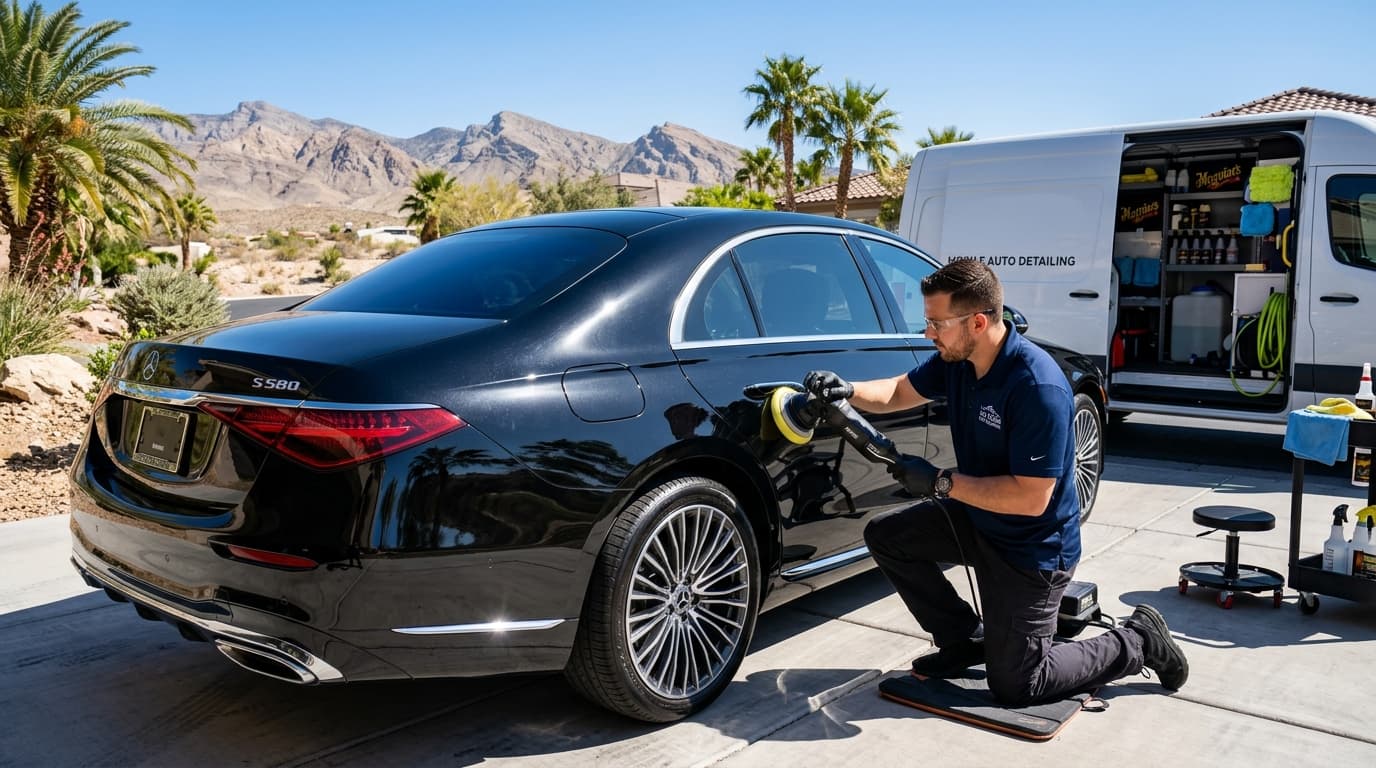
AOA Detailing serves Las Vegas, Henderson, Summerlin, North Las Vegas, and surrounding areas within 25 miles — we come to you. No dropping off. No waiting room.
If your car is showing swirl marks, Kevin, Founder of AOA Detailing, will assess the paint condition, explain what correction level is appropriate, and give you an honest quote before any work begins.
Call or text: (775) 244-5315
Or book online and we’ll schedule at a time that works for you.
For more on protecting your paint after correction, see our ceramic coating service and our guide to black car paint maintenance in Las Vegas — the tips apply to any dark color, not just black.
AOA Detailing is a mobile auto detailing service based in Las Vegas, NV, serving clients within 25 miles including Henderson, Summerlin, North Las Vegas, Spring Valley, and Boulder City. All paint correction is performed by Kevin, Founder of AOA Detailing. Contact: (775) 244-5315 | info@aoa-detailing.com