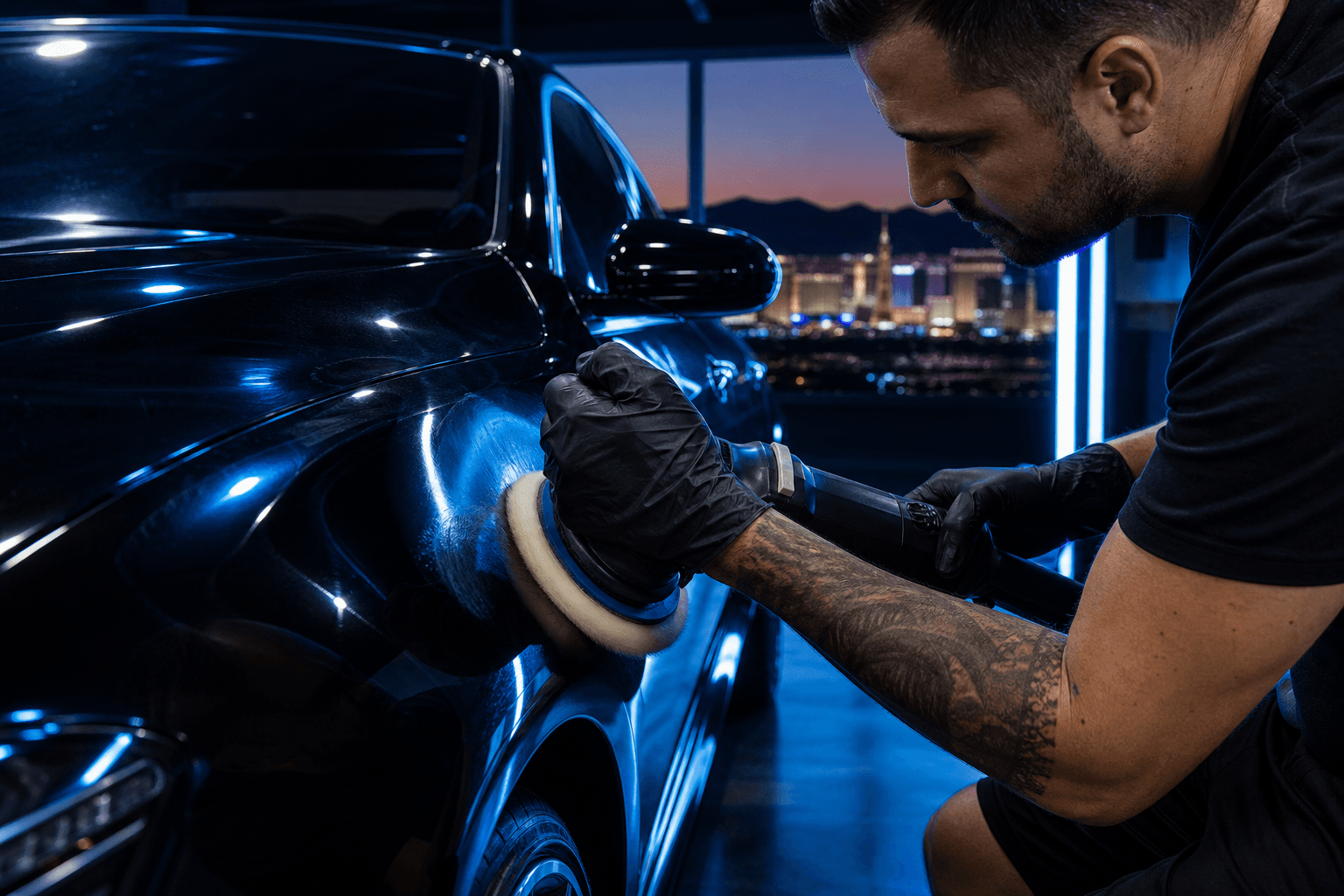
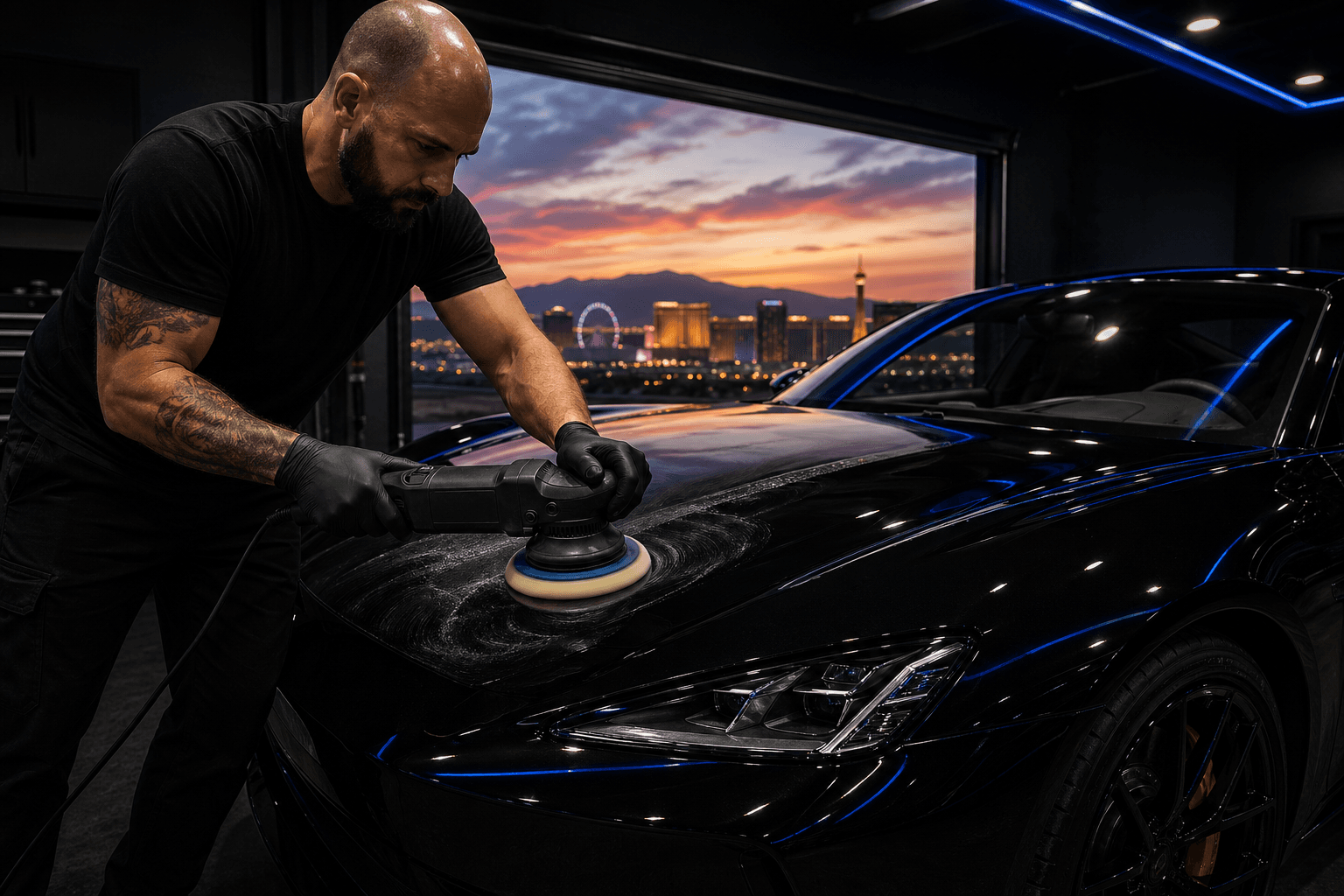
What Are Swirl Marks — and Why Is Las Vegas So Hard on Your Paint?
If you’ve ever walked around your car in bright sunlight and noticed a web of fine circular scratches spinning out across the clear coat, you’re looking at swirl marks. They’re one of the most common complaints Kevin hears at AOA Detailing, and they’re also one of the most misunderstood.
Swirl marks aren’t just cosmetic annoyances. They’re micro-scratches in your clear coat caused by improper washing, dirty cloths, automatic car washes, and — ironically — inexperienced buffing jobs. In Las Vegas, the problem compounds fast. Fine Mojave desert dust settles on your paint every single day, and when you drag a dry cloth or run through a brush-style car wash, you’re essentially sanding your paint with grit.
Here’s what makes Las Vegas especially brutal on paint:
- Desert dust and silica — fine abrasive particles that sit on your surface and get dragged across it with every wipe
- Intense UV radiation — weakens clear coat over time, making it more susceptible to scratching
- Extreme temperature swings — thermal expansion and contraction stress paint layers
- Minerals in tap water — leave behind etch marks and mineral deposits when water evaporates in the heat
The result? Even relatively new cars in Las Vegas can show paint defects that look years older than they should.
Buffer Scratches vs. Swirl Marks: What’s the Difference?
These terms often get used interchangeably, but they’re different in origin — and the distinction matters for how they’re fixed.
Swirl marks are fine, circular scratches typically created during washing or drying. They appear as a spider-web or vortex pattern under direct sunlight or a single-point light source. They come from:
- Automatic car washes with brushes
- Washing with dirty sponges or cloths
- Wiping dust off a dry car
- Circular hand-washing motions with abrasive material
Buffer scratches are heavier, often linear or arc-shaped scratches left by an improperly used polishing machine. They’re caused by:
- Too much pad pressure in one area
- Wrong pad/compound combination for the paint hardness
- Inexperienced operators running a rotary buffer
- Cutting compound left too long without removal
Buffer scratches are usually deeper than swirl marks and can require more aggressive correction to remove. In some cases, a previous “detail job” actually made things worse — Kevin has seen many cars come in with fresh buffer trails from a well-meaning but undertrained detailer.
The good news: both types of defects respond well to professional paint correction.
How Paint Correction Actually Works
Paint correction is not polishing your car with a fancy machine. Done right, it’s a systematic, multi-stage process that permanently removes defects from the clear coat — not just fills or masks them.
Here’s how Kevin approaches paint correction at AOA Detailing:
Stage 1: Thorough Decontamination
Before any machine touches your paint, the car gets a full decontamination wash — iron remover, clay bar treatment, and a final rinse. Any contamination left on the surface during correction becomes an abrasive. This step is non-negotiable.
Stage 2: Paint Thickness Measurement
Kevin uses a paint depth gauge to map the clear coat thickness across every panel. This tells him how much material he can safely remove and flags any areas with previous respray work (where the clear coat may be thinner).
Stage 3: Test Spot
A small, inconspicuous test area is corrected first using the planned compound and pad combination. This confirms the approach will work on your specific paint hardness and validates the expected results.
Stage 4: Machine Polishing — One or Two Stages
Single-stage correction uses a medium compound and polishing pad to address light-to-moderate swirl marks. It removes defects and leaves a refined finish in one pass.
Two-stage correction is for heavier defects like deep swirl marks, buffer scratches, and RIDS (random isolated deep scratches). Stage one cuts the paint with a more aggressive compound to remove the defects. Stage two refines with a lighter polish to remove haze and maximize gloss.
Stage 5: Final Inspection
Under a paint inspection light, every panel is checked at multiple angles. Any remaining high spots or missed areas get corrected before the car is considered done.
Stage 6: Protection
A freshly corrected car is extremely vulnerable — the clear coat is clean and open. AOA Detailing recommends applying a ceramic coating after paint correction to lock in the results and protect against future defects.
Who Needs Paint Correction? Signs Your Car Is a Candidate
Not every car needs full paint correction. But certain signs mean it’s worth getting an assessment:
- Spider-web swirling visible in sunlight — especially on dark-colored vehicles
- Dull or hazy finish despite regular washing
- Light scratches in clear coat that don’t catch a fingernail
- Oxidation on older vehicles (paint looks chalky or faded)
- Preparing for ceramic coating — correction is recommended before any coating application
- Pre-sale or pre-lease-return — paint correction dramatically increases perceived value
If your car has scratches that catch a fingernail, or damage that goes through the clear coat to the base coat, paint correction alone won’t fully fix it — that’s a body shop situation. Kevin will tell you honestly what’s achievable versus what needs panel repair.
How Long Does Paint Correction Last?
This depends entirely on how you maintain the car afterward.
Without protection: A corrected paint surface will start accumulating new swirl marks within weeks, especially in Las Vegas driving conditions.
With ceramic coating: Results can last 3–5+ years. The ceramic layer creates a hard, semi-permanent barrier that’s far more resistant to micro-scratching than bare clear coat. It also makes the surface hydrophobic — water and dust bead off rather than sitting and getting dragged across the paint.
With proper washing habits: Two-bucket method, microfiber wash mitts, no automatic car washes — you can maintain a corrected finish for years.
Kevin often recommends pairing a paint correction with a ceramic coating as a single appointment. You get the paint corrected to the best possible condition, then seal those results permanently. The combination is genuinely the highest-quality paint protection available for a Las Vegas vehicle.
DIY Paint Correction: Is It Worth Trying?
There’s a market for consumer polishers, and some car enthusiasts do excellent DIY work. But for Las Vegas car owners who just want their paint to look good, DIY correction carries real risks:
- Wrong compound + pad = deeper scratches. A rotary buffer in inexperienced hands can create buffer scratches worse than the original swirl marks.
- No paint depth gauge = risk of burning through. On factory paint, especially on soft German cars or re-sprayed panels, it’s easy to remove too much material.
- Cheap pads leave haze. Consumer foam pads often don’t refine the finish well enough to achieve genuine clarity.
- Time and mess. A proper two-stage correction on a full-size sedan takes 8–12 hours for an experienced detailer. For a beginner, expect longer and uncertain results.
If you have a beater car or you’re learning the craft, DIY polishing makes sense. If you care about the outcome and want results that last, professional correction is the more cost-effective choice long-term.
AOA Detailing Paint Correction: Las Vegas, Henderson, and Beyond
Kevin at AOA Detailing performs professional paint correction throughout Las Vegas and surrounding areas including Henderson, Summerlin, North Las Vegas, Spring Valley, and Boulder City — within 25 miles of Las Vegas. Everything is fully mobile; he comes to your driveway, parking garage, or workplace.
Paint Correction pricing:
- Single-stage correction: from $550
- Two-stage (full) correction: up to $950
Ready to get your paint looking better than it did when you drove it off the lot? Book your paint correction appointment or call (775) 244-5315 to talk through what your car needs.
You can also explore AOA’s full detailing packages or learn more about Henderson-area mobile detailing if you’re not sure which service fits best.
Ready to Transform Your Vehicle?
AOA Detailing serves Las Vegas, Henderson, Summerlin, and surrounding areas. Get a free quote today.