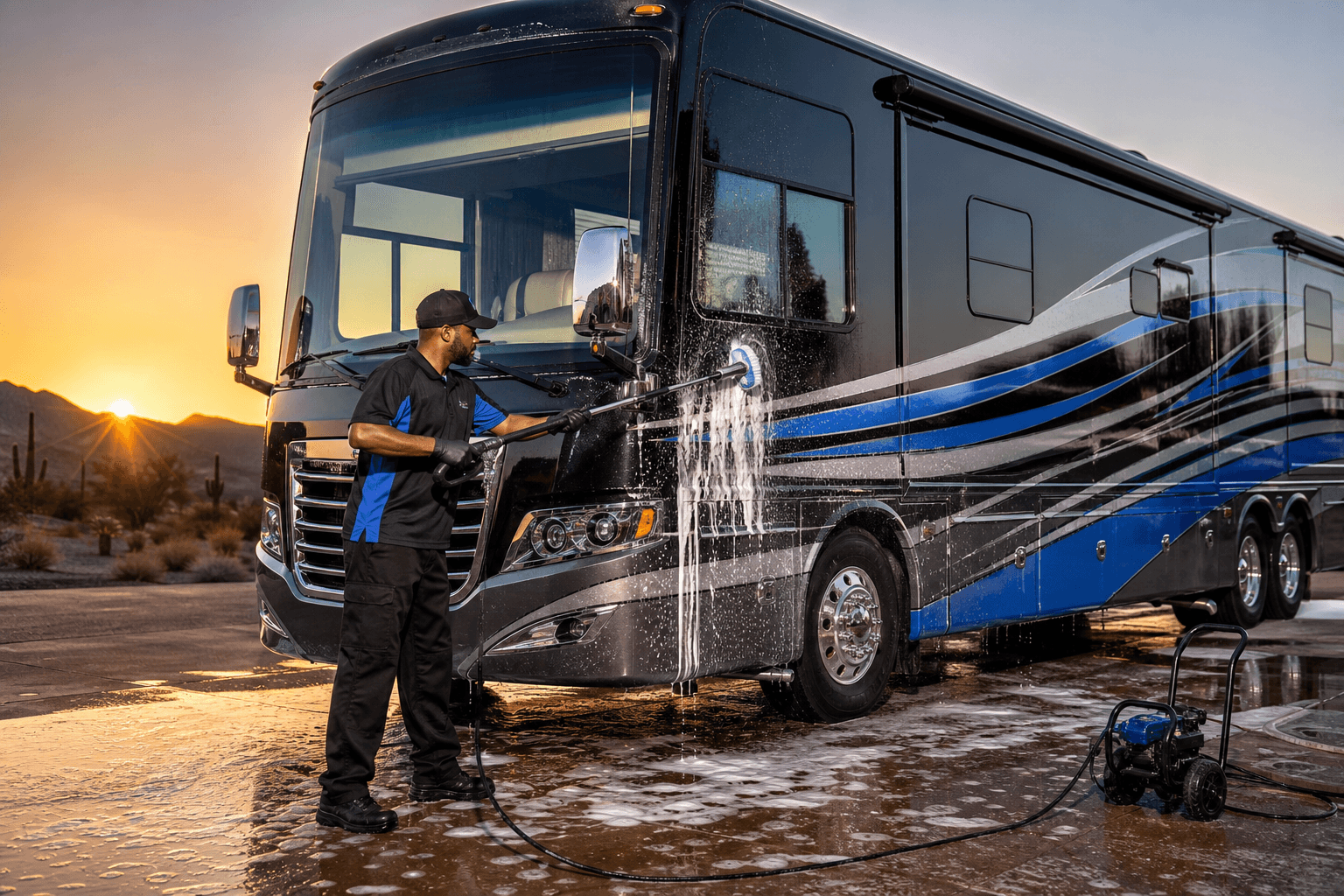
Step 1: Full Exterior Wash and Roof Cleaning
Before applying any protection, the exterior must be thoroughly cleaned — and for RVs, the roof demands as much attention as the sides.
Why the Roof Matters Most
RV roofs accumulate a toxic mix of bird droppings, tree sap, oxidized EPDM rubber residue, air pollution deposits, and mineral-heavy water stains from rain and sprinkler systems. Left on the surface during a storage period, these compounds continue to chemically react with the roof membrane and fiberglass components.
For EPDM rubber roofs (common on travel trailers and Class C motorhomes), acidic deposits can accelerate cracking and delamination. For fiberglass roofs (common on Class A motorhomes), UV-exposed surface oxidation gets worse beneath any layer of grime that traps heat.
The professional cleaning process uses pH-appropriate cleaners for each surface zone — RV-safe detergent on fiberglass, rubber-compatible solution on EPDM, and non-abrasive rinse methods that avoid forcing water into seam areas where it can migrate into the substrate.
Slide-Out Tracks and Seals
Slide-out mechanisms accumulate significant debris in their tracks. Before storage, these should be cleared and inspected — debris trapped in the track during storage can damage seal edges when you extend the slide on your next trip. Kevin and his team clean and lubricate all accessible slide tracks as part of the pre-storage preparation.
Step 2: Paint and Fiberglass Decontamination
Washing removes surface dirt, but embedded contaminants — industrial fallout particles, tree sap residue, mineral etch marks, and microscopic debris — require decontamination to fully remove.
Clay Bar Treatment
A clay bar treatment physically removes embedded surface contamination that a wash can’t dislodge. Running a clay bar across your RV’s exterior surfaces pulls contamination out of the paint or gel coat, leaving behind a genuinely clean surface that’s ready to accept protective coatings.
For RVs going into storage, decontamination before applying wax or sealant is particularly important: protective products applied over contaminated surfaces bond inconsistently, leaving gaps where UV and moisture can penetrate.
Water Spot Treatment
Las Vegas tap water is notoriously hard — high in calcium and magnesium. Sprinkler overspray, outdoor washing, and even heavy dew leave behind calcified mineral deposits when they evaporate on hot surfaces. On RV fiberglass, these deposits can etch through clear coat in as little as a few weeks in summer heat.
Professional water spot removal uses pH-balanced mineral removers followed by light polish to restore the surface before applying protection. If water spot damage has already progressed to light etching, a mild abrasive polish step can restore clarity before sealing.
Step 3: Wax, Sealant, or Ceramic Coating Application
The goal of pre-storage exterior protection is to put a durable barrier between your RV’s surfaces and the elements during the period when you won’t be regularly washing and inspecting it.
Carnauba Wax (1–3 Month Protection)
Traditional carnauba wax provides a warm, deep-looking finish and about 1–3 months of meaningful UV protection. For RVs stored for a single season, a quality carnauba application before storage provides adequate protection — with the understanding that you’ll want to rewax before the next trip season.
Paint Sealant (6–12 Month Protection)
A synthetic paint sealant typically outperforms carnauba in durability (6–12 months) and is the preferred choice for Las Vegas RV owners storing for a full season. Sealants form a harder, more heat-resistant bond than carnauba, providing better UV blocking through a full Las Vegas summer.
Ceramic Coating (Multi-Year Protection)
For RV owners who want maximum protection with minimal ongoing maintenance, a ceramic coating is the premium option. Ceramic coatings provide 3–5+ year durability, near-permanent hydrophobic properties (water and minerals bead off rather than bonding), and measurable UV blocking that significantly slows fiberglass oxidation.
The upfront cost is higher than wax or sealant, but the per-year cost advantage becomes clear when you factor in the restoration detailing and polish work that unprotected RVs require every few seasons. AOA Detailing applies ceramic coatings to RVs across Las Vegas and the surrounding valley — contact Kevin at (775) 244-5315 for a custom quote.
Step 4: Tire and Wheel Treatment
RV tires are particularly vulnerable to UV damage because of their large exposed surface area and the fact that stored RVs don’t flex and work the rubber the way driving tires do.
UV Protectant Application
A quality tire UV protectant (non-petroleum-based — petroleum products can actually accelerate cracking) applied to sidewalls before storage meaningfully slows ozone and UV degradation. The difference between a properly treated and untreated tire sidewall after a Las Vegas summer in storage is visible — treated tires stay supple; untreated tires develop surface cracking that shortens remaining service life.
Tire Covers
In addition to UV protectant, tire covers for outdoor storage dramatically extend tire life. If your RV lives outdoors in a storage lot, invest in fitted tire covers for each wheel — the UV blocking they provide over a multi-month storage period compounds into real tire lifespan extension.
Wheel Cleaning and Sealant
Brake dust, road grime, and mineral deposits on wheels are best removed before storage. Baked-on contaminants become increasingly difficult to remove the longer they sit, and alkaline brake dust is chemically reactive with aluminum alloy wheels. Applying a wheel sealant after cleaning protects the surface through the storage period.
Step 5: Interior Preparation
The interior of a stored RV in Las Vegas faces a different set of challenges than the exterior: extreme heat buildup (interior temperatures can exceed 140–150°F in direct sun), potential moisture accumulation from climate changes, and the general desiccation that arid desert air causes to fabric, leather, and vinyl surfaces.
Thorough Interior Deep Clean
Before storage, a complete interior vacuuming, surface wipe-down, and fabric/upholstery extraction removes food particles, organic debris, and dust that can become food sources for mold during storage or attract pests. In Las Vegas, the dry climate reduces mold risk compared to humid regions, but sealed RVs with trapped organic material and intermittent humidity (from climate change cycles) can still develop odor problems.
Kevin’s interior pre-storage process includes:
- Full vacuum of all carpet, upholstery, and slide-out flooring
- Wipe-down of all hard surfaces with appropriate cleaners
- Upholstery extraction where needed
- Cabinet and storage compartment cleaning
Leather and Vinyl Conditioning
Leather and quality vinyl surfaces in stored RVs face aggressive desiccation in Las Vegas heat. Proper conditioning before storage (using a pH-balanced, heat-stable automotive leather conditioner) fortifies the material against the drying that would otherwise cause surface cracking and stitching stress over a storage period.
Slide-Out Seal Treatment
Rubber slide-out seals are among the most replacement-prone components on Las Vegas RVs. UV exposure and extreme heat dry them out, causing them to crack, harden, and eventually lose their sealing function. Before storage, applying a dedicated rubber seal conditioner to all slide-out perimeter seals (and window and door seals) helps maintain flexibility through the storage period.
Step 6: Final Walkthrough and Roof Sealant Inspection
A responsible pre-storage detail includes a roof sealant inspection — checking all seam sealant around vents, air conditioner bases, antennas, and other roof penetrations for cracking or gaps.
Las Vegas heat cycles cause thermal expansion and contraction that stresses roof sealant year-round. A small gap in roof sealant — invisible at ground level — can admit enough moisture during a rain event to cause interior delamination and water damage. Catching and repairing failing sealant before storage prevents damage that’s far more expensive to address after it’s occurred.
While AOA Detailing is a detailing service (not a structural repair service), we flag any visible sealant concerns during our pre-storage walk-around so owners can address them before the vehicle sits unattended for months.
Pre-Storage RV Detailing Checklist
Here’s a summary of what a complete professional pre-storage detail covers:
| Area |
Service |
| Exterior |
Full wash, roof cleaning, slide-out track cleaning |
| Paint/Fiberglass |
Clay bar decontamination, water spot treatment |
| Protection |
Wax, sealant, or ceramic coating application |
| Tires & Wheels |
UV protectant, wheel cleaning and sealant |
| Interior |
Full vacuum, surface clean, fabric extraction |
| Leather/Vinyl |
Conditioning treatment |
| Seals |
Slide-out, window, and door seal conditioning |
| Roof |
Sealant inspection and condition report |
When to Schedule Pre-Storage Detailing
For Las Vegas RV owners, the two most common storage transition points are:
Before Summer Storage (April–May): Many Las Vegas RV owners park their rigs during the peak heat months (June–August) when extreme temperatures make extended trips uncomfortable. Detailing before summer storage protects surfaces through the most UV-intense period of the year.
Before Winter Storage (October–November): Owners who return from fall road trip season and park for winter benefit from pre-storage detailing that removes road grime, insects, and campsite debris accumulated during the trip season.
For either transition, scheduling at least 1–2 weeks before your planned storage date gives time for ceramic coating cure periods (if applicable) and allows any issues identified during the walk-around to be addressed.
Frequently Asked Questions
How long does a pre-storage RV detail take?
A complete pre-storage detail for a standard travel trailer takes 4–6 hours; a full-size Class A motorhome typically takes 6–8+ hours. We schedule accordingly and bring all necessary supplies directly to your home, driveway, or storage facility.
Can you detail my RV at the storage facility?
Yes — AOA Detailing is fully mobile and brings all water, power, and equipment. We can work at most outdoor storage facilities within 25 miles of Las Vegas, though it’s worth confirming with your storage facility that exterior detailing is permitted.
How much does pre-storage RV detailing cost?
Pricing depends on RV size and condition. Visit our RV detailing service page for current pricing or call (775) 244-5315 for a custom quote.
Is ceramic coating worth it for an RV?
For Las Vegas owners who store their RV outdoors and take 1–3 trips per year, ceramic coating pays for itself in reduced restoration work within 2–3 seasons. The UV protection and hydrophobic properties are especially valuable in a desert climate. See our full ceramic coating service for details.
Do I need to do anything after retrieval from storage?
Yes — a post-storage inspection detail after retrieving your RV is equally valuable. This catches any issues that developed during storage (water intrusion, pest activity, dust accumulation) and refreshes the protective layer before your first trip.
Book Your Pre-Storage RV Detail in Las Vegas
Kevin and the AOA Detailing team provide fully mobile RV detailing across Las Vegas, Henderson, Summerlin, North Las Vegas, Spring Valley, and all areas within 25 miles.
We come to your driveway, parking area, or storage facility — no drop-off required. Book your RV detail today or call (775) 244-5315 to discuss your RV’s specific needs and get a custom quote.