The Unique Challenges of Black Paint
1. Swirl Marks Are Instantly Visible
On white or silver cars, light swirl marks — the fine circular scratches caused by improper washing technique, automatic car washes, or even microfiber wipe-downs — are nearly invisible except in direct sunlight. On a black car, they create a spiderweb pattern that’s visible in virtually any lighting condition.
This matters in Las Vegas because the intense, unfiltered desert sunlight acts like a spotlight on your paint. Every car wash, every wipe-down, and every time a shopping cart gets too close contributes to a cumulative swirl problem that’s uniquely punishing on dark paint.
2. Water Spots Etch Quickly and Show Starkly
Las Vegas has notoriously hard water — water that carries high concentrations of calcium, magnesium, and other dissolved minerals. When that water sits on a hot black hood in direct sunlight, it evaporates in minutes, leaving behind a concentrated mineral deposit that begins etching into the clear coat.
Research from the Water Quality Association ranks Las Vegas Valley Water District among the hardest water supplies in the United States, with hardness levels commonly exceeding 280 mg/L. On black paint, even a brief sprinkler hit or a rain shower followed by direct sun can leave permanent white mineral rings that require professional paint correction to remove.
3. UV Oxidation Turns Black Paint Chalky and Dull
Prolonged UV exposure breaks down the polymers in your car’s clear coat and base coat. On black vehicles, this produces a grey, chalky, faded appearance — often described as looking “washed out” or dusty even when the car is clean. Stage 1 oxidation affects the clear coat and can often be corrected with polishing; Stage 2 reaches the base coat and is irreversible without repainting.
Las Vegas UV index regularly exceeds 10 (the extreme threshold) from May through September. For comparison, cities like Seattle or Chicago rarely exceed UV index 8 even in summer. If your black car isn’t protected, that UV exposure is silently degrading your paint every hour it sits outside.
How Ceramic Coating Protects Black Paint Specifically
Ceramic coating bonds at the molecular level with your car’s clear coat, creating a semi-permanent layer of protection that addresses the three major threats black paint faces.
Hydrophobic Surface = Fewer Water Spots
Ceramic coating creates an ultra-slick, hydrophobic surface where water beads up and rolls off rather than sitting and evaporating. This drastically reduces mineral deposit formation — the same hard water that would etch an unprotected surface slides right off a coated one.
In a practical sense, this means that even when sprinkler overspray hits a ceramic-coated black car in a Las Vegas parking lot, the water beads off instead of settling into surface micro-pores and drying into a mineral stain.
9H+ Hardness Provides Scratch and Swirl Resistance
Professional-grade ceramic coatings are rated on a pencil hardness scale. Quality coatings achieve 9H+ — harder than the paint itself. This additional surface hardness helps resist the fine scratches from car washes, dust, and light contact that cause swirl marks to accumulate.
This doesn’t make your car scratch-proof — nothing short of armor-grade paint protection film will do that — but it significantly reduces the rate at which swirl marks accumulate, keeping your black paint looking polished much longer between correction sessions.
UV Blockers Prevent Oxidation
Ceramic coating contains UV blockers that absorb and dissipate UV radiation before it reaches the clear coat beneath. For black cars in Las Vegas, this is arguably the most critical benefit — without UV protection, you’re simply watching the clock on your paint’s lifespan.
Easier Maintenance and Longer-Lasting Gloss
Because ceramic coating is significantly harder and slicker than bare clear coat, contaminants don’t bond as readily. This means each wash is faster and more effective, and the glossy, wet-look finish that makes black cars so appealing lasts far longer between detail sessions.
What the Ceramic Coating Process Looks Like
AOA Detailing’s ceramic coating service is fully mobile — Kevin comes to your Las Vegas home, apartment, or office. The process typically takes a full day and includes these steps:
Step 1: Paint Decontamination
Before any coating can be applied, the paint must be completely clean at the microscopic level. This means a thorough wash, followed by an iron decontamination spray that dissolves embedded metallic particles from brake dust and rail dust, and a clay bar treatment that removes surface-bonded contaminants.
If this step is skipped or rushed, contamination gets permanently sealed beneath the coating — which is why spray-on “ceramic” products from auto parts stores rarely perform like professional coatings.
Step 2: Paint Correction (If Needed)
Ceramic coating locks in the condition of your paint at the time of application. If there are swirl marks, water spot etching, or light scratches, they need to be corrected before coating — because the coating will make them permanent.
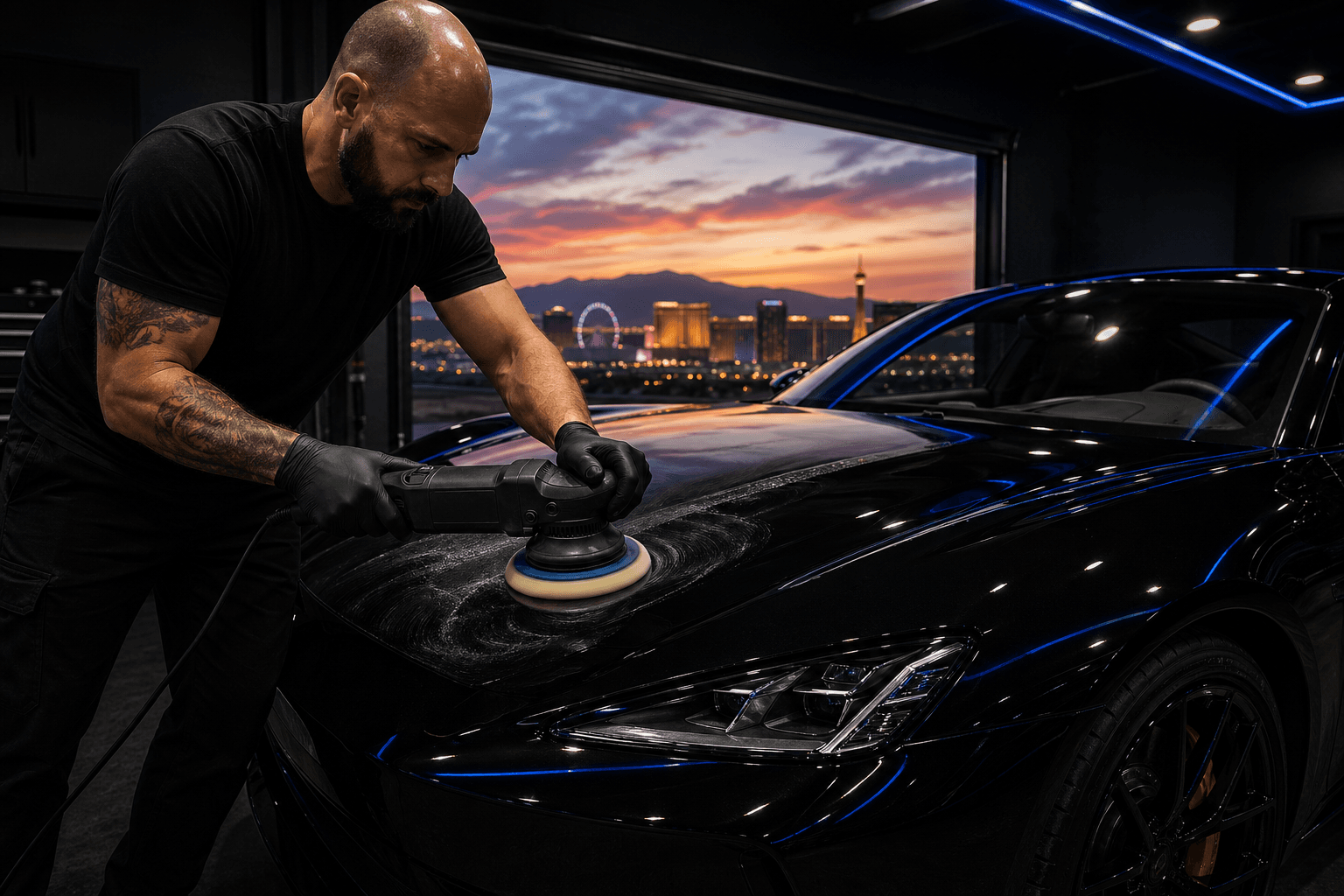
For black cars with significant swirl accumulation, this usually means at least a one-stage machine polish. For more severely damaged paint, a two-stage paint correction process may be required. Kevin assesses your paint under proper LED lighting before quoting — you’ll know exactly what the paint needs before work begins.
Step 3: Panel Wipe with IPA
After correction, each panel is wiped down with an isopropyl alcohol solution to remove all polishing oils. This step is critical — oil residue from polishing compounds prevents the ceramic coating from achieving a proper chemical bond with the clear coat.
Step 4: Ceramic Coating Application
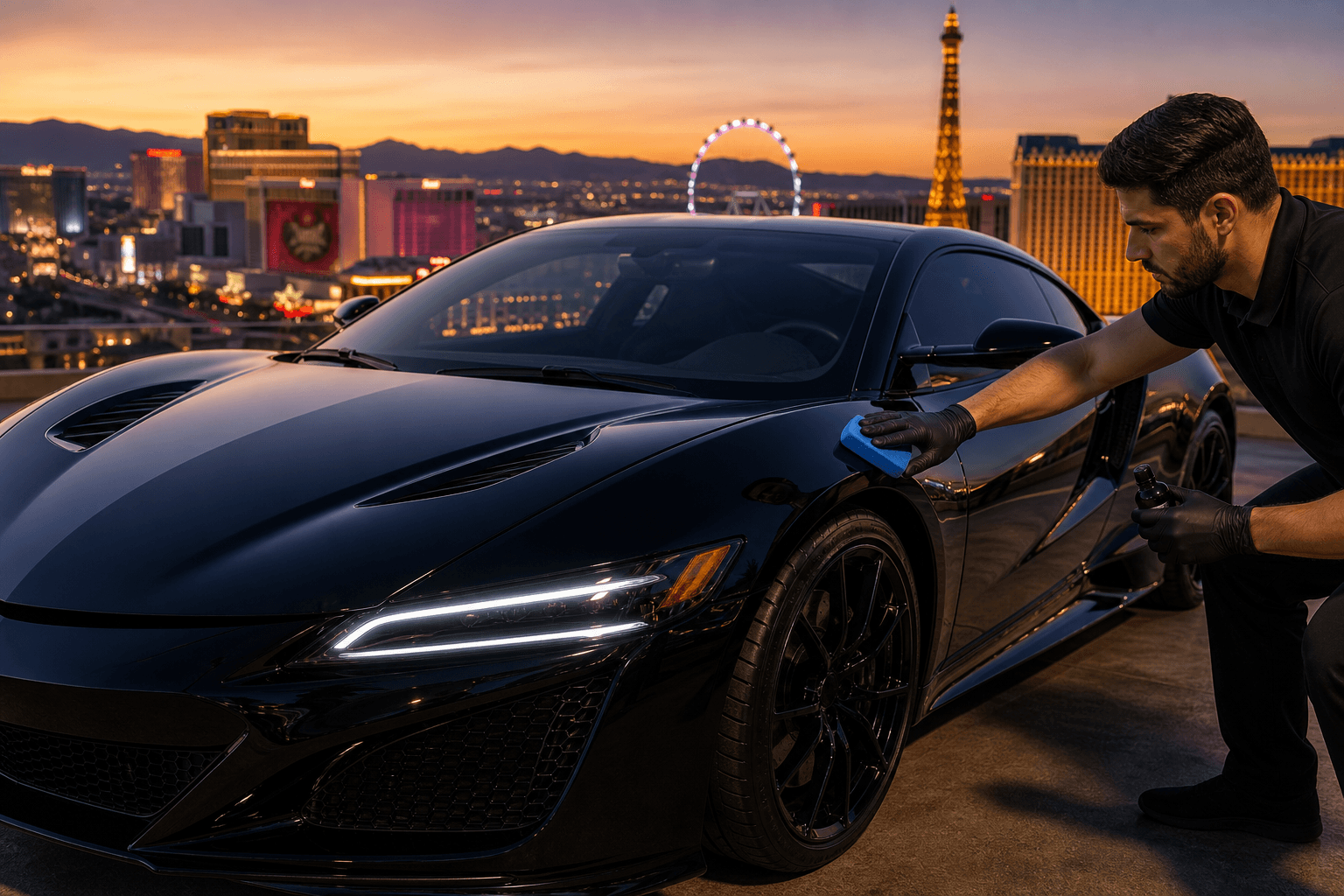
The coating is applied one panel at a time using a specialized foam applicator and microfiber wrap. Working in small sections, the coating is spread evenly and then leveled as it flashes (begins to cure). The timing at this stage is crucial — both the ambient temperature and the car’s surface temperature affect flash time significantly.
Las Vegas heat means Kevin and the team typically work in the early morning or late afternoon — direct sun on a 90°F+ day can make coating application extremely difficult, which is another reason a reputable mobile detailer understands and adapts to local conditions.
Step 5: Cure Time and First Wash Instructions
After application, the coating needs to cure. During the first 24–48 hours, the car should stay dry and avoid contaminant exposure. After the initial cure window, you’ll receive specific first-wash instructions — typically waiting a full 7 days before the first wash.
The coating reaches full hardness over approximately 2–4 weeks. During this period, normal driving is fine; just avoid harsh wash methods and abrasive products.
How Long Does Ceramic Coating Last?
Professional ceramic coatings applied correctly typically last 3–5 years with proper maintenance — some multi-layer or graphene-based products push toward 5–7 years under ideal conditions.
Consumer-grade spray ceramic products sold at auto parts stores, by comparison, typically last 3–6 months before their limited bonding capacity breaks down and requires reapplication.
The difference comes down to coating concentration, application technique, and surface prep. Professional application ensures the coating is applied at the right thickness with proper surface bonding — producing lasting protection that spray-on products simply can’t replicate.
Annual Maintenance Tips for Black Cars
To maximize longevity on your ceramic-coated black car, Kevin recommends:
- pH-neutral car wash soap — never automatic car washes with harsh brushes
- Two-bucket wash method — one bucket of soapy water, one of rinse water, to avoid cross-contaminating your wash mitt
- Annual inspection and top-coat — a quick coating refresh or maintenance spray at the 12–18 month mark extends coating life and maintains hydrophobic performance
- Avoid parking under trees when possible — tree sap is one of the few contaminants aggressive enough to degrade coating performance if left sitting
Is Paint Correction Required Before Coating My Black Car?
The honest answer: it depends on the current condition of your paint.
If your black car already has visible swirl marks, water spots, or light scratches, those need to be corrected before coating. Coating over damaged paint doesn’t hide the damage — the coating’s high gloss actually amplifies reflectivity, which makes swirl marks and surface defects more visible, not less.
The good news: many Las Vegas black car owners who’ve kept their car garaged, washed carefully, or have lower-mileage vehicles have paint in excellent condition that requires only a light polish or decontamination before coating.
The step before any ceramic coating appointment is always a paint inspection. Book an assessment and Kevin will evaluate your paint condition and give you a clear picture of what’s needed.
Ceramic Coating vs. Wax for Black Cars in Las Vegas
|
Wax |
Ceramic Coating |
| Lifespan |
6–12 weeks |
3–5 years |
| UV Protection |
Moderate |
Strong |
| Hydrophobic Performance |
Good initially |
Excellent, sustained |
| Scratch/Swirl Resistance |
None |
Significant improvement |
| Las Vegas Heat Resistance |
Degrades at high temps |
Stable to 1,000°F+ |
| Reapplication |
Every 2–3 months |
Once every few years |
The math is straightforward: ceramic coating requires higher upfront investment but costs significantly less over time than repeated waxing cycles — while providing substantially better protection in extreme conditions like Las Vegas.
Why Choose AOA Detailing for Ceramic Coating in Las Vegas?
AOA Detailing is a mobile-first operation based in Las Vegas. Kevin comes to you — your home, apartment, office, or storage facility. No drop-off, no shuttle, no waiting room.
Kevin has applied ceramic coating to hundreds of vehicles across the valley — from daily drivers to show cars, from entry-level sedans to six-figure exotics. If you’re driving a black car in Las Vegas, protecting that paint is one of the best investments you can make in the vehicle’s appearance and long-term resale value.
Service Area: Las Vegas, Henderson, Summerlin, North Las Vegas, Spring Valley, and all locations within 25 miles of Las Vegas.
📞 (775) 244-5315 | Schedule Online
Frequently Asked Questions
How much does ceramic coating cost for a black car in Las Vegas?
AOA Detailing’s ceramic coating packages range from $1,000–$1,650 depending on vehicle size and paint condition. Pricing includes the full prep process — decontamination, paint correction assessment, and coating application.
Does ceramic coating prevent scratches?
Ceramic coating significantly increases the hardness of your car’s surface, providing meaningful resistance to fine swirl marks and light scratching. It is not a substitute for paint protection film (PPF) if you want protection from rock chips and deeper scratches.
Can ceramic coating be applied to a black car with existing swirl marks?
Only after paint correction. Swirl marks must be polished out first — coating over damage seals it in permanently. Kevin assesses every vehicle’s paint before quoting.
How do I maintain a ceramic-coated black car?
Use pH-neutral soap, wash by hand with a two-bucket method, and avoid automatic car washes. Schedule an annual maintenance appointment to inspect the coating and apply a top-coat if needed.
How long does the ceramic coating appointment take?
Most black car ceramic coating appointments take 6–10 hours depending on vehicle size, paint condition, and any correction work needed. Kevin will give you a specific time estimate after the initial assessment.
Kevin, Founder of AOA Detailing, brings professional mobile detailing and ceramic coating services to Las Vegas, NV and surrounding areas. Call (775) 244-5315 or book online to protect your black car.