Why Stains Are Harder to Remove in Las Vegas
Las Vegas heat does something sneaky to car stains. The moment a spill hits your upholstery, the 100°F+ temperatures inside a parked car essentially bake it in. What might wipe up easily in a cooler climate turns into a set stain within minutes here.
This is one of the most common complaints we hear from customers at AOA Detailing: “I wiped it up right away — why is there still a mark?”
The answer is heat. Your car’s interior can reach 160°F on a hot Las Vegas day. That temperature accelerates oxidation, speeds up dye transfer, and causes liquid stains to bind tightly to fabric and leather fibers before you even make it back inside.
In this guide, Kevin from AOA Detailing breaks down how to handle the most common car seat stains — fabric, leather, and vinyl — and what mistakes to avoid that will make the stain permanent.
Know Your Seat Material First
Before you reach for any cleaner, identify what your seats are made of. Using the wrong product can permanently damage the material.
Fabric / Cloth: Most common on trucks, sedans, and older SUVs. Absorbs stains quickly and can trap odors. Responds well to enzyme-based cleaners and steam.
Leather: Premium and popular in Las Vegas luxury cars. More water-resistant than fabric, but the stitching and pores can trap pigments. Leather needs pH-balanced cleaners and should never be scrubbed aggressively or left wet.
Vinyl / Faux Leather: Common on newer vehicles. More resistant to staining than genuine leather, but can crack or fade with harsh solvents like acetone or bleach-based cleaners.
Alcantara / Suede: Found in performance and exotic cars. Extremely delicate — do not attempt DIY cleaning. Always go professional.
The Most Common Stains in Las Vegas Cars (and How to Handle Them)
Coffee and Energy Drinks
Las Vegas drivers are morning commuters and late-night workers — coffee and energy drink spills are everywhere.
For fabric seats:
- Blot (don’t rub) immediately with a clean, dry cloth.
- Mix one tablespoon of dish soap with two cups of cold water.
- Apply with a clean cloth, working from the outside of the stain inward.
- Blot dry. Repeat if needed.
- Let air dry with the doors open.
For leather seats:
Use a leather-safe upholstery cleaner. Do not use water alone — tannins in coffee can stain leather permanently if not treated with the right product. Always condition leather after cleaning.
What not to do: Don’t use hot water — it sets the stain. Don’t scrub in circles — it spreads the stain and damages fibers.
Food Grease and Fast Food Spills
In-car dining is a Las Vegas reality. Grease stains need a different approach than liquid spills.
For fabric:
- Scrape off any solids first.
- Sprinkle baking soda or cornstarch on the stain and let it sit for 15–20 minutes to absorb the grease.
- Vacuum the powder.
- Apply a small amount of dish soap directly to the stain.
- Work in with a soft-bristle brush, then blot with a damp cloth.
For leather:
Apply a small amount of leather cleaner and gently work it in with a soft microfiber cloth. Do not use dish soap on leather — it strips the protective coating.
Sunscreen
Sunscreen is one of the worst culprits for car seat staining in Las Vegas. The oxybenzone and avobenzone in many sunscreens react with UV light and can leave a rust-orange stain on leather that looks permanent.
For leather:
- Act fast — sunscreen stains worsen with heat and light.
- Use an enzyme-based upholstery cleaner or a dedicated leather cleaner.
- Apply with a soft cloth and blot — do not scrub.
- Condition the leather after to restore moisture.
For fabric:
Pre-treat with an enzyme cleaner, let it sit for five minutes, then blot with a damp cloth. If the stain has set, a professional steam clean is often the only option.
Prevention tip: Keep a small towel on your seat when you know you’ve applied sunscreen. This is a genuinely common issue we deal with in Las Vegas.
Pet Accidents
If you travel with pets in Las Vegas, pet stains on car seats are almost inevitable. The bigger concern beyond the visible stain is the odor — urine contains uric acid crystals that bind to fabric fibers and release ammonia-like odors in heat.
For fabric:
- Blot up as much liquid as possible immediately.
- Apply an enzyme-based pet stain remover (not a general fabric cleaner — enzymes are essential for breaking down uric acid).
- Let the product dwell for 10–15 minutes before blotting.
- Allow to fully air dry.
- If odor remains, a professional hot water extraction or steam clean is needed.
For leather:
Blot immediately and apply a leather-safe enzyme cleaner. Do not let urine sit on leather — the acid will begin degrading the surface.
Ink and Dye Transfer
Denim dye transfer on light-colored leather seats is extremely common in Las Vegas. So is ink from pens left in cup holders or doors.
For ink (fabric):
Apply isopropyl alcohol (70%) to a clean cloth — do not pour directly. Blot the stain. Change cloths frequently to avoid spreading the ink.
For ink (leather):
Use a small amount of rubbing alcohol on a cotton swab. Work carefully from the edges inward. Follow immediately with leather conditioner.
For dye transfer (leather):
This is tricky. A leather cleaner can help with fresh transfers, but set dye transfer often requires professional color correction. Prevention is the best strategy here — use a seat cover if you regularly wear dark denim.
Vomit (Motion Sickness and Kids)
This is the one most people want to skip over, but it’s a real-world interior detailing problem — especially with kids in the car on long desert drives.
For fabric:
- Remove solids immediately.
- Rinse with cold water (not hot — heat sets the proteins).
- Apply an enzyme-based cleaner designed for biological stains.
- Let it work for 15 minutes, then blot dry.
- Odor will persist if the pad underneath the fabric is soaked — professional steam cleaning with hot water extraction is the only way to fully address deep contamination.
For leather:
Wipe off immediately, clean with a pH-balanced leather cleaner, and condition after. The acids in vomit are hard on leather finishes.
When DIY Isn’t Enough
There are situations where at-home stain removal makes things worse — or where the stain has simply progressed beyond what household products can handle:
- Set stains baked in by Las Vegas heat — The proteins and dyes have bonded to fibers at the molecular level.
- Odors that return after cleaning — You’ve cleaned the surface but not the underlying pad or foam.
- Leather discoloration — Color loss or bleaching from chemical overuse requires professional color restoration.
- Mold from moisture trapped in fabric — Happens when a wet stain isn’t dried properly. Requires professional remediation.
- Alcantara or suede — These materials should always be handled by a professional.
Kevin at AOA Detailing handles all of these situations with professional-grade steam equipment, enzyme treatments, and interior detail packages designed for Las Vegas driving conditions.
AOA’s Professional Interior Stain Treatment Process
When you book an interior detail with AOA Detailing, here’s what actually happens with stubborn stains:
- Material assessment — We identify the seat material and the stain type before applying anything.
- Pre-treatment — Enzyme cleaners or pre-conditioners are applied and allowed to dwell based on stain type.
- Agitation — Soft brushes work the treatment into the fibers without damaging them.
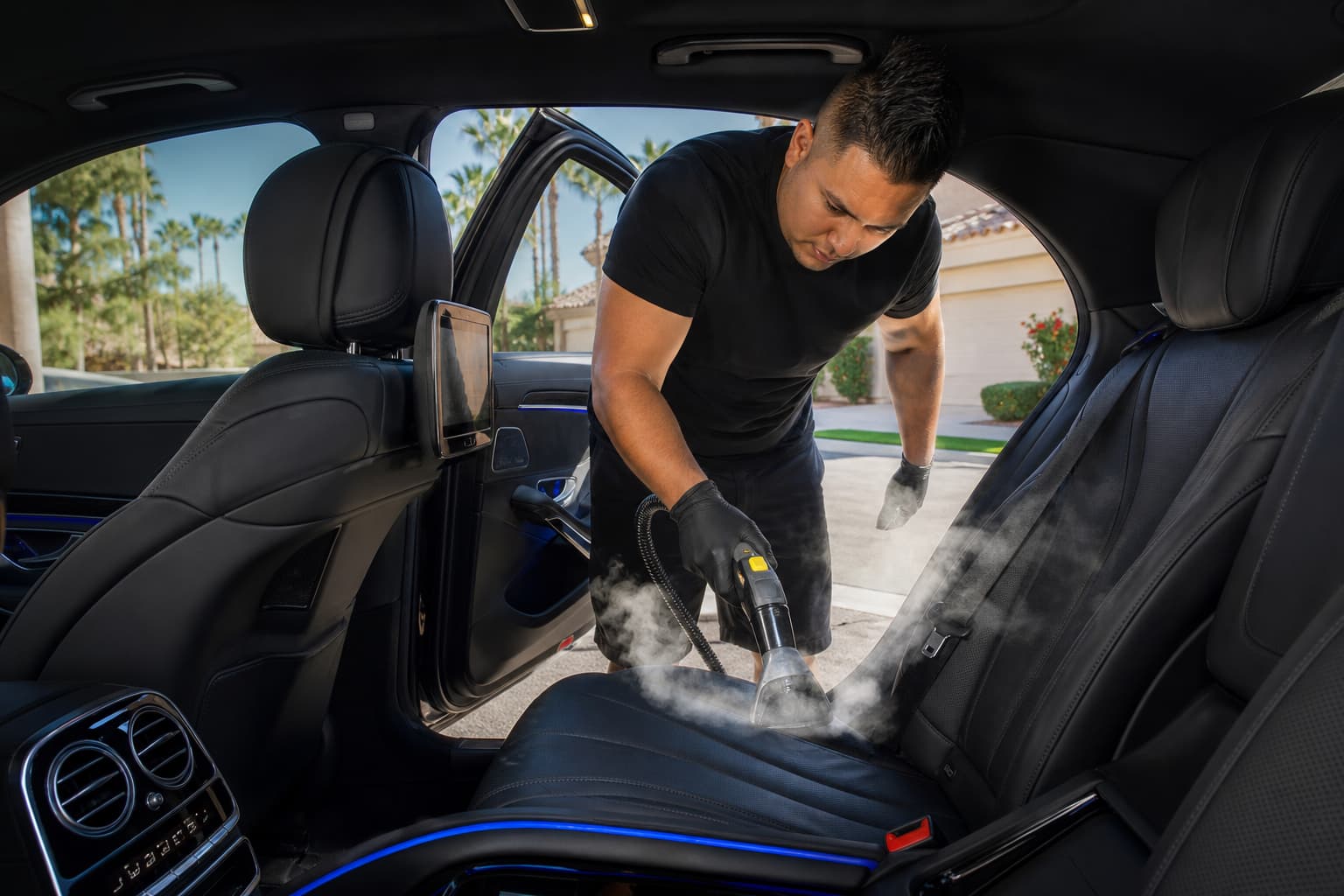
- Extraction — Steam cleaning and hot water extraction pulls the stain and the treatment out of the fabric.
- Drying — Air circulation is used to prevent mold and odor from moisture.
- Protection — Leather is conditioned; fabric gets a protective coating to resist future stains.
Our interior detailing service covers seats, carpets, door panels, headliner, and trim — not just spot treatment. If your car’s interior needs more than one cleaned seat, a full interior detail is usually the better value.
Where We Serve
AOA Detailing is mobile — we come to you anywhere within 25 miles of Las Vegas. That includes Henderson, Summerlin, North Las Vegas, and Spring Valley.
We can detail your car at your home, office, or apartment complex — no shop visit required.
Frequently Asked Questions
Can baking soda remove car seat stains?
Baking soda is helpful for absorbing grease and neutralizing odors, but it won’t remove a stain on its own. It works best as a pre-treatment step before applying a cleaner.
Does hydrogen peroxide work on car seat stains?
Hydrogen peroxide can remove some stains on light-colored fabric seats, but it can bleach darker fabrics and should never be used on leather. Use with caution and test in a hidden spot first.
How do I get rid of the smell after cleaning a car seat stain?
If odor persists after cleaning, the stain likely penetrated the seat padding. Enzyme-based cleaners help break down the odor-causing compounds, but professional steam extraction is often needed for complete odor removal.
Is it worth getting my car seats professionally detailed in Las Vegas?
Absolutely — especially for set stains, odors, or if your seats are leather or premium materials. Professional equipment removes stains that household products can’t reach, and professional conditioning protects your investment in the Las Vegas heat.
Ready to give your car’s interior a fresh start? Call Kevin at AOA Detailing at (775) 244-5315 or book an appointment online. We serve Las Vegas and surrounding areas within 25 miles — mobile detailing at your location.