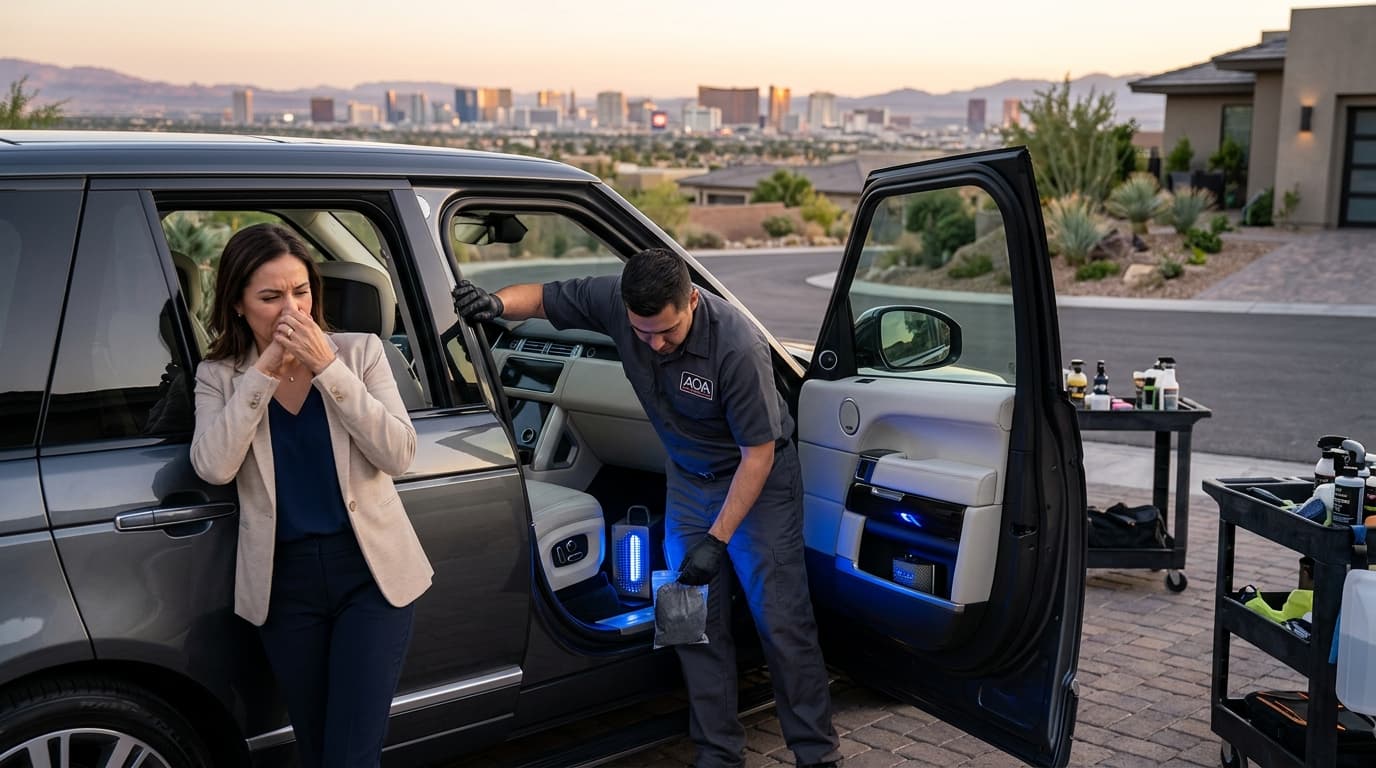
That Smell Isn’t Going Away on Its Own — Especially in Las Vegas
You’ve tried the air freshener. You’ve sprinkled baking soda and vacuumed it up. You’ve left the windows cracked. The smell is still there.
In most places, a stubborn car odor is a nuisance. In Las Vegas, it becomes a permanent fixture — because the heat doesn’t just amplify odors, it drives them deep into porous materials and effectively bakes them in. Cigarette smoke, pet dander, spilled coffee, gym bags, fast food — once Las Vegas summer heat gets to work, these odors bond with your carpet fibers, foam padding, and headliner in ways that no air freshener can touch.
At AOA Detailing, we get calls about persistent car odors every week. The customers are always frustrated for the same reason: they’ve tried everything they can think of and nothing worked. This guide explains why, what actually does work, and when it’s time to bring in professional equipment.
Quick Summary- Las Vegas temperatures can exceed 160°F inside a parked car — baking odors deep into upholstery, carpet, and foam padding
- Air fresheners and sprays mask odors; they don't eliminate the odor source
- Cigarette smoke, pet odor, food, and mildew each require different treatment approaches
- DIY methods work for mild, recent odors — deep or old odors almost always need professional treatment
- Start with an assessment of the odor source and suitable cleaning options; do not assume ozone will resolve the problem.
- A full interior detail removes the physical residue that produces the smell in the first place
Why Las Vegas Makes Car Odors Worse
Most odor advice online is written for mild climates. It misses what happens in a desert city like Las Vegas.
When you park your car on a summer afternoon in Summerlin or Henderson, the cabin temperature can hit 160°F to 180°F within minutes. That extreme heat does two things to odors:
It activates volatile organic compounds (VOCs). The molecules responsible for odors become more active at high temperatures — they off-gas more aggressively, penetrating deeper into porous surfaces like carpet backing, foam seat padding, and headliner fabric. A spill that might have stayed near the surface in a mild climate gets driven several layers deep in Las Vegas heat.
It dehydrates the materials holding the odor. Our desert air — often at single-digit humidity — desiccates carpet and upholstery fibers, causing them to contract around absorbed odor molecules. This traps the smell inside the material rather than allowing it to off-gas and dissipate naturally over time.
The result: odors that in other climates might fade within a few weeks become essentially permanent without targeted treatment.
The Most Common Car Odors (and What’s Actually Causing Them)
Understanding the odor source is the first step to choosing the right treatment:
Cigarette or cannabis smoke — The most penetrating of all car odors. Smoke particles and tar residue coat every surface, including the HVAC system. Heat re-activates trapped smoke compounds every time you park in the sun. Standard cleaning rarely touches this fully.
Pet odor — Dog and cat dander, oils from fur, and occasional accidents produce a layered odor. The protein compounds in pet waste are especially reactive with heat. Pet odors almost always require enzyme treatment to neutralize rather than mask.
Food and beverage spills — Coffee, fast food, and sugary drinks ferment in Las Vegas heat within hours. The liquid soaks into carpet padding where mold and bacteria begin growing within 24–48 hours in warm conditions — long before visible mold appears.
Musty or mildew smell — Usually caused by moisture in the carpet (from spills, wet shoes, or AC condensation that backed up under the dash). The low humidity in Las Vegas can slow visible mold growth, but the bacteria responsible for that musty smell don’t need much moisture to thrive.
Gym bag / body odor — Sweat contains proteins and bacteria that bond aggressively to cloth seats and carpet. In Las Vegas heat, these compounds off-gas continuously, making the interior smell occupied even when the car sits empty.
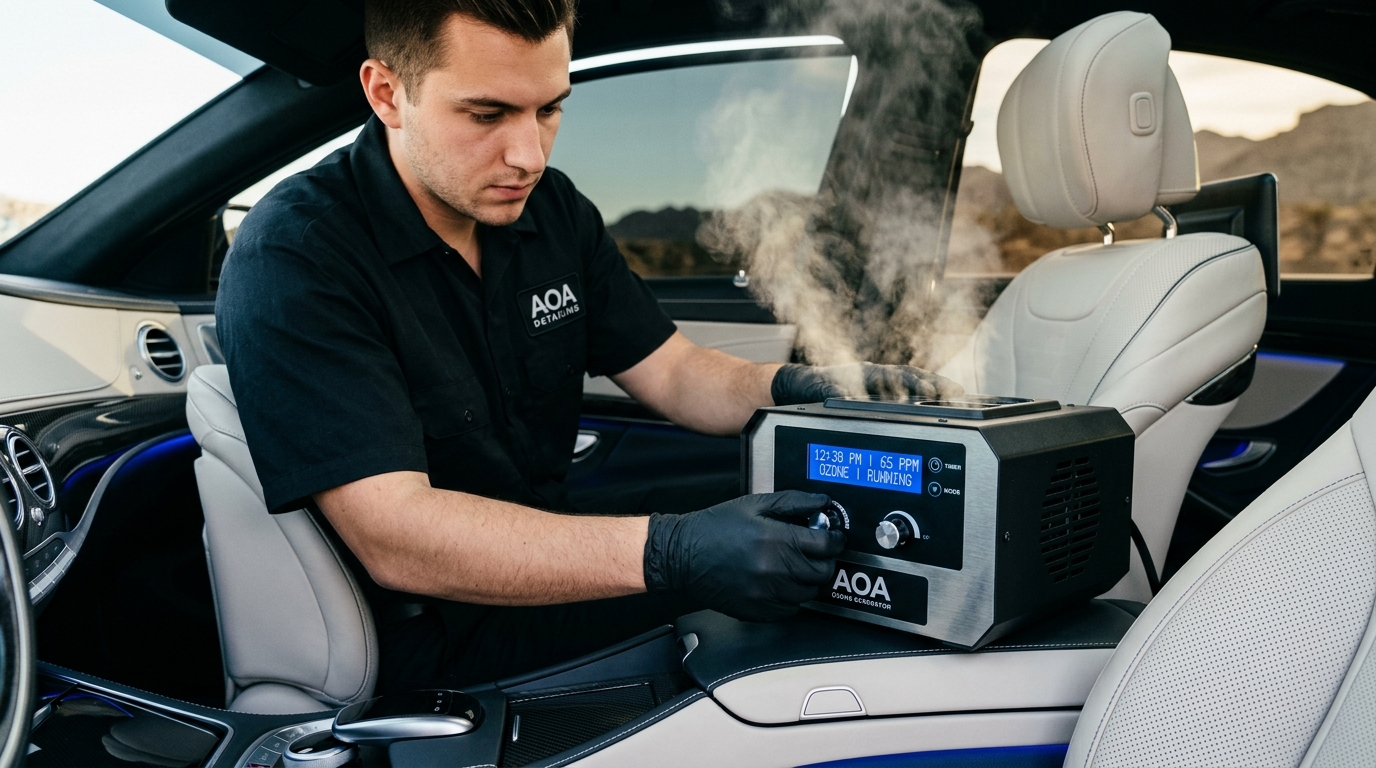
Ozone is not a substitute for locating and addressing the odor source. EPA cautions that ozone has limited effectiveness at concentrations within public-health limits and may not affect contamination embedded in porous materials.
DIY Methods: What Works, What Doesn’t
What actually helps:
- Thorough vacuuming — Removing physical debris eliminates a portion of the odor source. Use a crevice tool to get under seats and into seat-back folds. This alone won’t eliminate deep odors but it’s a mandatory first step.
- Baking soda on carpet/seats — Sprinkle liberally, leave for several hours (or overnight), then vacuum. Effective for mild, surface-level odors. Won’t penetrate into padding.
- Activated charcoal bags — Placed inside the car for several days, these can absorb mild ambient odors. They work slowly and best for maintenance, not recovery.
- White vinegar solution — A 50/50 dilution wiped on hard surfaces (not cloth or leather) can neutralize some odor compounds. Use cautiously — it can damage finishes if left to sit.
What doesn’t work:
- Air fresheners and sprays — These add a masking fragrance. The odor source remains untouched and will re-emerge, often mixing with the air freshener smell into something worse.
- Febreze-type fabric sprays — Effective for mild, recent surface odors. For anything penetrating into padding or trapped by Las Vegas heat, these don’t reach deep enough.
- Leaving windows open — Ventilation helps with surface-level off-gassing but doesn’t neutralize odor compounds embedded in materials.
A good rule of thumb: if you’ve tried DIY methods twice without lasting improvement, the odor source is deeper than surface treatment can reach.
When to Call a Professional
Consider professional odor treatment when:
- The smell returns within a week of DIY treatment
- The odor is clearly cigarette smoke, pet waste, or mold-related
- The car was closed up in Las Vegas summer heat for an extended period
- You can’t identify the source (odor may be in HVAC, under seats, or in the headliner)
- You’re preparing the car for resale and want an assessment of a persistent odor.
AOA’s interior-detailing process starts with an inspection and assessment of interior condition. Describe any persistent odor, water intrusion or suspected mold before agreeing on the scope of work. An assessment is not a promise that the smell will never return.
Professional Odor Elimination Methods
Ozone: Limits and Precautions
The EPA’s indoor-air guidance warns that ozone can harm health. At concentrations within public-health limits, it does not effectively remove mold and other biological pollutants; even higher concentrations may not affect contamination embedded in porous materials. That guidance does not support a blanket promise to destroy mold throughout a car.
Controlled professional use is a separate question. Toyota’s water-intrusion bulletin includes an ozone step after cleaning and reassembly for its covered vehicles. It requires leak repair and replacement of affected absorbent parts, and excludes severe water intrusion and general HVAC odors. This is dealer guidance, not a DIY method or proof of AOA’s equipment, training or results.
Enzyme Treatment
Enzyme cleaners contain biological agents that break down organic compounds — specifically the proteins in pet urine, blood, vomit, and food. These are the odors that traditional cleaners can’t touch because they don’t neutralize the compound, they just move it around. Enzyme treatment is applied directly to the affected area, allowed to dwell, and then extracted.
Steam Cleaning
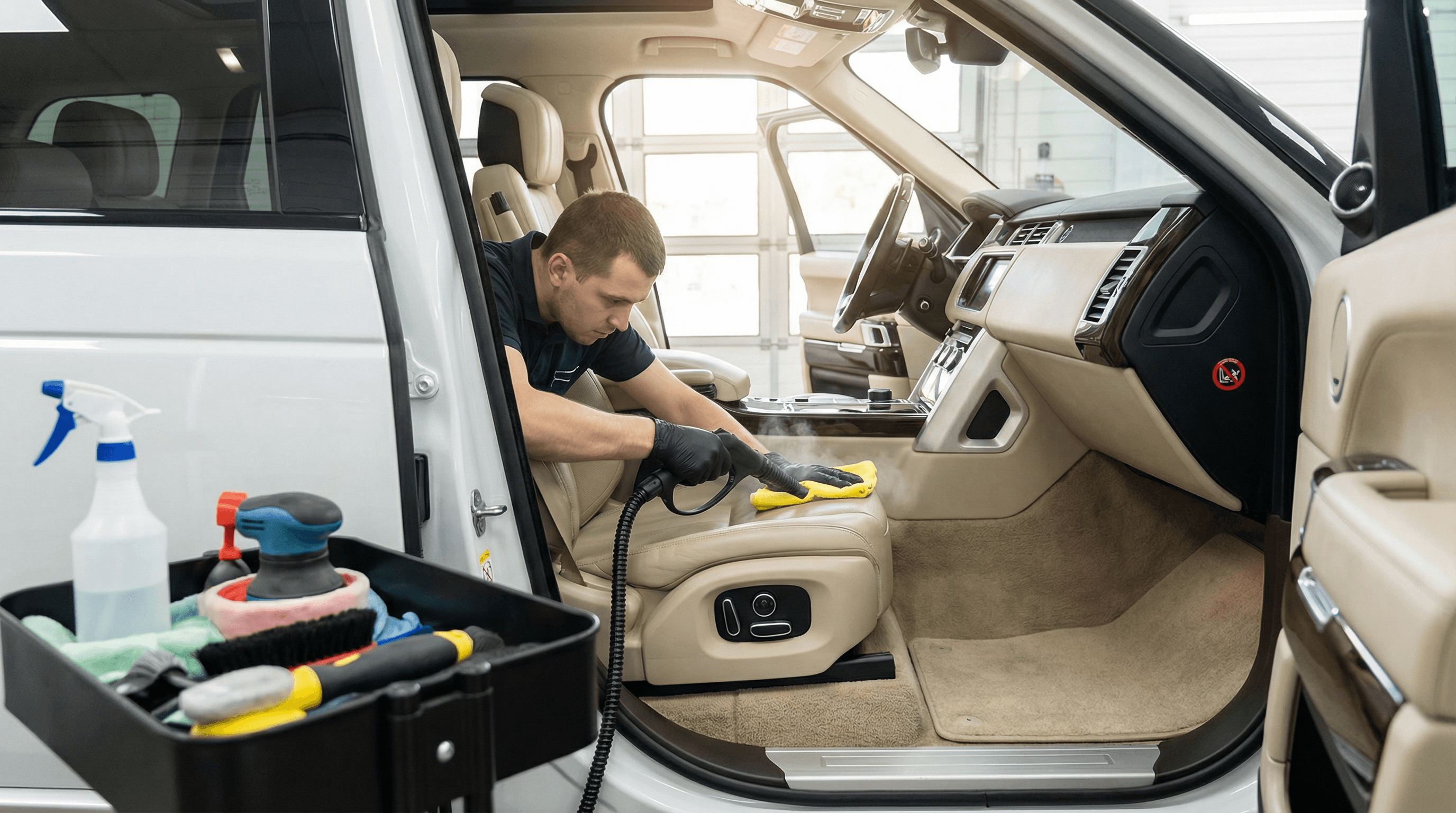
High-temperature steam cleaning sanitizes surfaces and helps loosen embedded odor compounds for extraction. It’s particularly effective for cloth seats and carpet. For Las Vegas heat-baked odors, steam is typically combined with enzyme or chemical treatment rather than used alone.
Deep Interior Detail
AOA’s full-detail page lists hot-water extraction for seats or carpets and an odor treatment among its add-ons. Confirm the proposed work and its limits with the team. Those listings do not establish a service that removes hidden mold, repairs leaks or guarantees a safe cabin; disclose suspected mold before booking ordinary detailing.
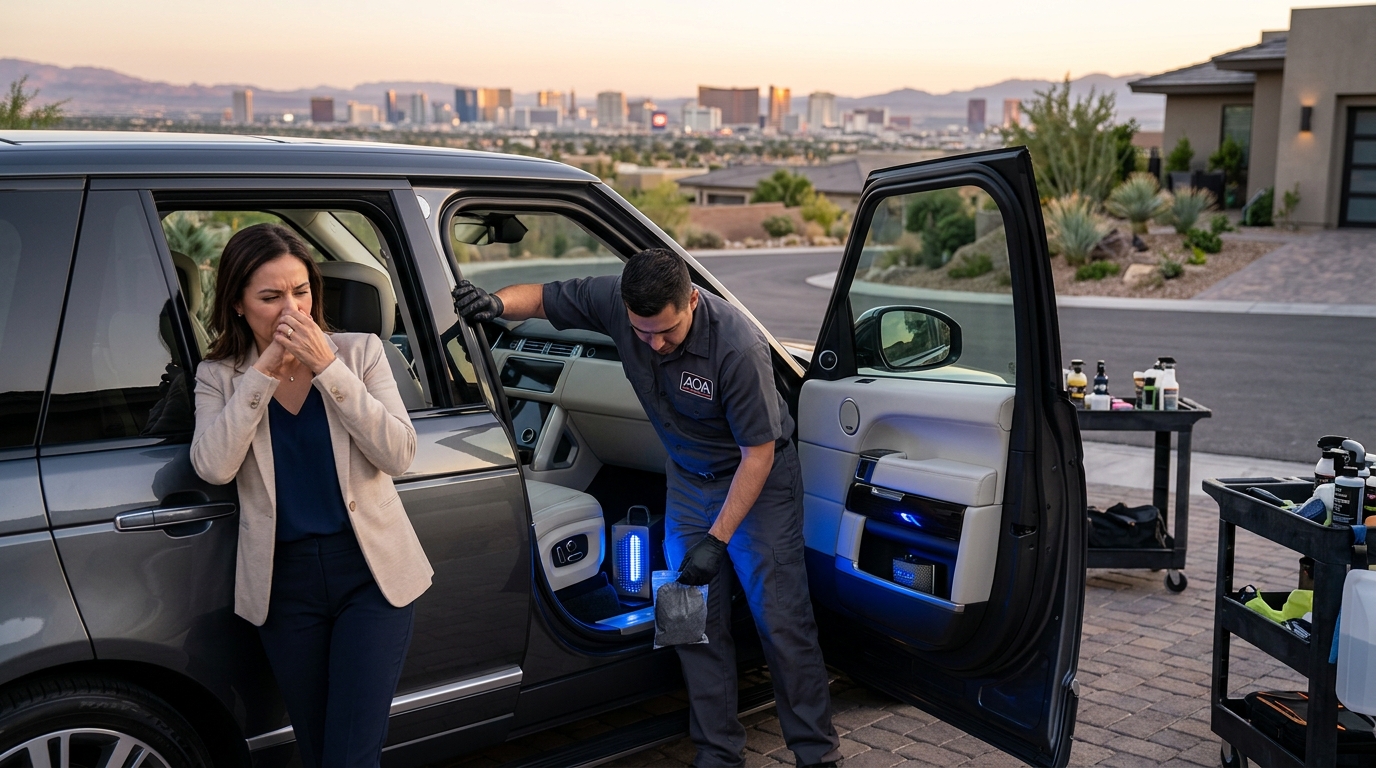
AOA Detailing brings professional odor elimination equipment directly to your driveway — no shop drop-off required, serving Las Vegas, Henderson, Summerlin, and the greater valley.
How to Prevent Car Odors in Las Vegas
Once your car is odor-free, keep it that way:
- Park in shade or use a windshield reflector — Limiting peak heat reduces the rate at which spills and residue bond with materials
- Address spills immediately — Blot (don’t rub) and treat within the first hour. Speed matters enormously in Las Vegas heat
- Vacuum weekly if you have pets or kids — Remove physical debris before it has time to embed
- Leave a small activated charcoal bag in the car — Ongoing maintenance absorption prevents buildup
- Run the AC on fresh air mode periodically — Recirculated air traps odor compounds inside the cabin
- Schedule interior detailing every 3–4 months — Professional extraction keeps materials clean at a level that preserves both appearance and freshness
For Las Vegas drivers, quarterly interior care is the threshold that separates cars that stay fresh from cars that gradually accumulate that unavoidable “used car” smell.
Frequently Asked Questions
How long does ozone treatment take, and when is re-entry safe?
Do not use this article to choose a treatment or re-entry time. EPA says ozone concentration depends on the equipment, space, materials and ventilation, and the absence of an ozone smell does not establish safety. A vehicle-specific professional procedure must not be turned into a universal wait-time rule.
Will ozone treatment damage my car’s interior?
EPA warns that ozone can damage materials including rubber, electrical-wire coatings and some fabrics or dyes. Ask for guidance specific to your vehicle and its materials before agreeing to treatment.
My car smells fine when cool but bad when hot — what’s happening?
This is classic heat-activated off-gassing. Odor compounds trapped in your carpet or padding are releasing as the car heats up. The smell is present all the time, but only detectable at temperature. This type of embedded odor requires extraction-level treatment, not surface spray.
Can cigarette-smoke odor be fully eliminated?
Ask for an assessment and a description of the proposed work and its limits. This article does not promise complete removal. EPA finds limited scientific support for broad ozone odor-removal claims, so an ozone step alone should not be treated as a guaranteed result.
How much does professional car odor removal cost?
Depending on severity, odor treatment ranges from an add-on to a full interior detail. Contact us at (775) 244-5315 for a free assessment — odor severity varies significantly and we’d rather give you an accurate quote than a number that doesn’t reflect your situation.
Ready to Breathe Easy Again?
If an odor persists, start with an assessment of its source and the affected materials. Disclose any water intrusion or suspected mold so the proposed work can be assessed before ordinary cleaning.
AOA Detailing serves Las Vegas, Henderson, Summerlin, North Las Vegas, Spring Valley, and the surrounding valley — we come to you, so your car gets treated in your driveway without the hassle of a shop drop-off.
Call or text (775) 244-5315 or book an interior-detail assessment and describe the odor or moisture problem before the appointment.